
REVIEW · OLD TOWN & ASTRONOMICAL CLOCK
WWII and Communism History in Prague’s Old Town Private Tour
History hits hard in Prague. This private tour connects WWII occupation and Communist rule to the streets you see today.
I like that the story is not just dates and slogans. You trace the arc from Nazi persecution through Prague’s resistance and liberation, then into how the Communists used that liberation for political power.
One thing to consider: the tour comes in two lengths. The 2-hour version covers the Old Town and main memorial stops, while the Museum of Communism is only included in the 4-hour option—so pick based on how much detail you want about life under communism.
In This Review
- Key things you’ll notice on this tour
- How Josefov and Old Town frame Prague’s WWII story
- Maisel and Spanish Synagogues: places that make the WWII facts land
- Operation Anthropoid, the 1945 Uprising, and the Old Town Clock with battle scars
- Petschek Palace: where the resistance fought back against the Gestapo
- Wenceslas Square: Nazi mass demonstrations and the Velvet Revolution
- The 4-hour option: the Museum of Communism and the everyday machinery of control
- Private guide quality: Sofija and Markéta set the tone
- Price, time, and value: what $104 gets you
- Who should book this tour
- Should you book this WWII and Communism tour in Prague’s Old Town?
- FAQ
- How long is the WWII and Communism History in Prague’s Old Town private tour?
- What’s included in the 2-hour option?
- What’s included in the 4-hour option?
- Where does the tour meet?
- Is the tour private?
- What languages are available for the guide?
- What parts of Prague does the tour cover?
- Does the tour cover the Velvet Revolution?
- Is the tour wheelchair accessible?
- Can I cancel for a full refund?
Key things you’ll notice on this tour
- A private history expert guide who can field real questions and keep the pace friendly
- Josefov walk with Maisel and Spanish Synagogues and the story of transports toward Theresienstadt
- Old Town Square + the Astronomical Clock tied to the 1945 fighting and the Prague Uprising
- Petschek Palace on the Gestapo doorstep, with a memorial plaque for Czech resistance fighters
- Wenceslas Square for the Velvet Revolution, the same square the Nazis used for mass demonstrations
- Museum of Communism in the 4-hour option, covering events like Prague Spring and Jan Palach
Still circling the Old Town? More of the square and its lanes, reviewed.
- Prague: Oldtown, Medieval Underground & Dungeon History Tour★ 4.3 · 10,277 reviews
- Prague: Old Town Hall Tower Entry Ticket★ 4.5 · 6,749 reviews
- Prague: 3-Hour Walking Tour of Old Town & Prague Castle★ 4.7 · 5,696 reviews
- Prague: 3-Hour Old Town and Prague Castle Tour in German★ 4.8 · 5,671 reviews
How Josefov and Old Town frame Prague’s WWII story
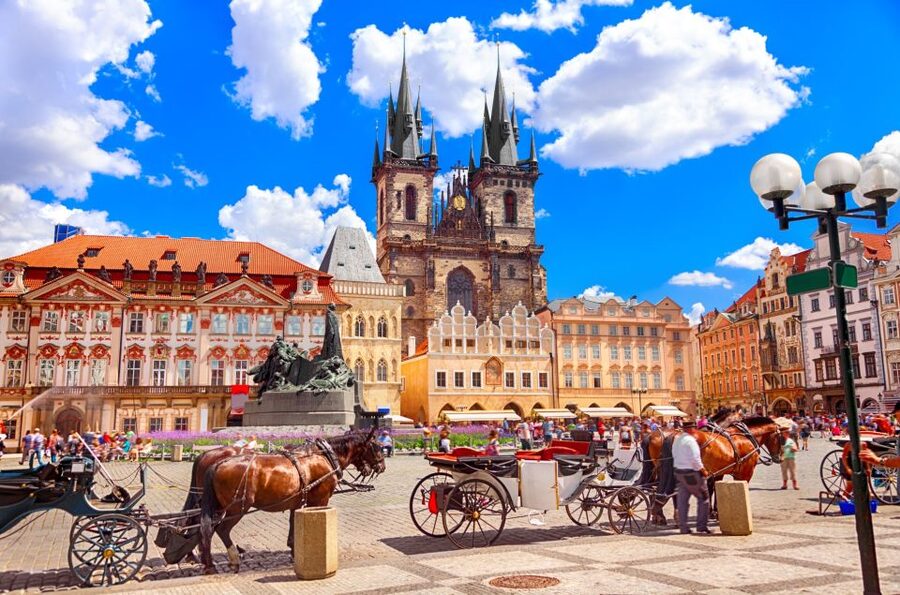
Prague’s Old Town can feel like a postcard on a quiet morning. This tour works because it puts that beauty in historical context—fast. You start in Josefov, move into the Old Town’s most famous civic spaces, and end at Wenceslas Square. Along the way, the guide connects personal stories and political decisions to specific buildings you can point at.
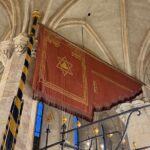
Josefov is the emotional starting point. This is one of the best-preserved Jewish quarters in Europe, and it matters because the tour uses the area as more than a walking backdrop. You’re there to understand what persecution looked like in a real neighborhood—who lived there, what institutions existed, and how that life was crushed by occupation policies.
Then Old Town Square enters the picture with a different tone: resistance, fighting, and the price of liberation. Even if you know the headline events, seeing them tied to the city’s landmarks helps your brain hold onto the story. That’s a big reason this route feels more satisfying than a facts-only museum run.
Maisel and Spanish Synagogues: places that make the WWII facts land
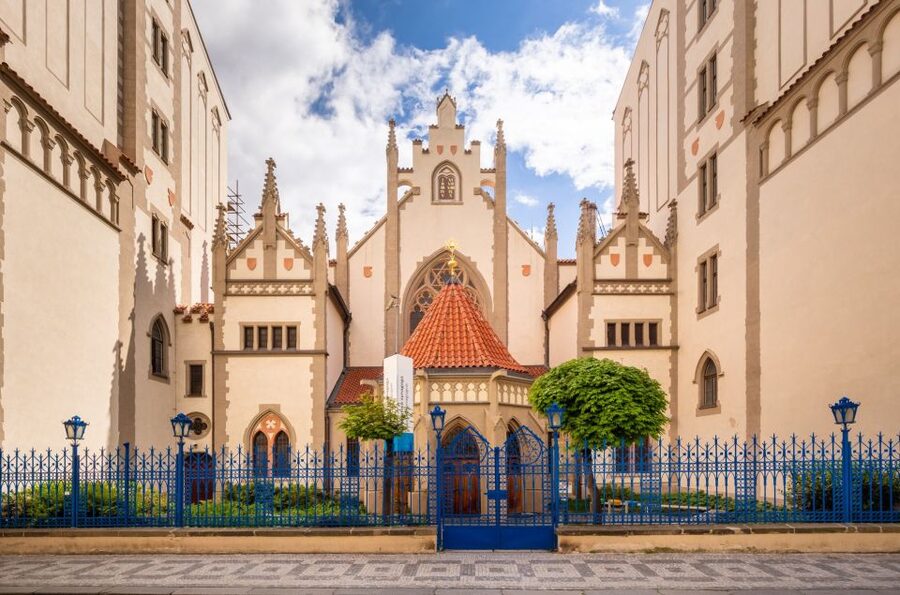
Your walk in Josefov includes two major synagogues: the Maisel Synagogue and the Spanish Synagogue. These aren’t just architectural stops. The guide uses them to set the human stage before the tour shifts to what the Nazis did to Czech Jews.
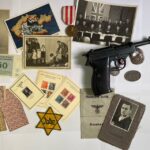
The key theme here is transportation and the machinery of persecution. You’ll hear about the horrors of the transportation of Czech Jews to the Theresienstadt concentration camp, and you’ll also hear about Hitler’s plan for a so-called museum idea around the extinct race. The phrasing can sound chillingly unreal, but the point is clear: propaganda and cruelty were tied together.
What I appreciate is how the tour keeps turning the lens outward. Instead of treating synagogues as silent objects, you connect them to community life—and then to what occupation changed. It’s heavy material, but it’s also concrete. You’re not stuck with generalities.
If you’re someone who gets overwhelmed by tragedy, this section may feel like a lot. But that’s also why it works: the tour doesn’t rush past the moral core of Prague’s WWII history.
Operation Anthropoid, the 1945 Uprising, and the Old Town Clock with battle scars

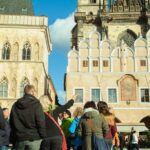
After Josefov, you move into the political and military heart of the city. Prague played an important role in defeating the Nazi regime, and your guide brings that to life through the Prague Uprising at the Old Town Square.
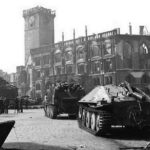
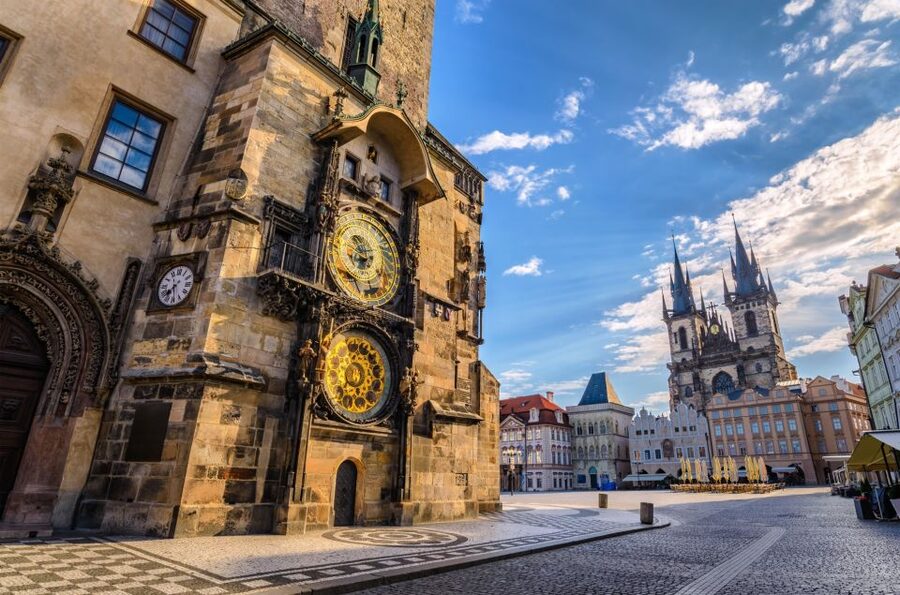
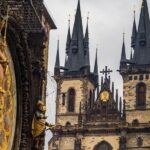
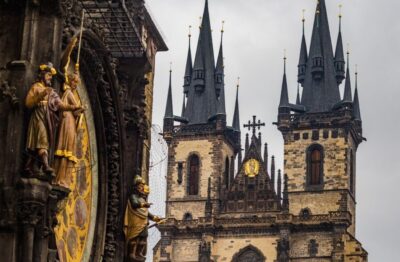
A highlight here is the Astronomical Clock on the facade of the Old Town Hall. The guide ties it to the fighting in early May 1945, when the building suffered heavy damage during the battles from May 5–9, 1945. Seeing a clock that’s usually treated as a fun photo stop placed inside a story of destruction and survival changes the way you look at it.
You’ll also get the broader timeline that makes those battles meaningful: events around the occupation and resistance, including references to Operation Anthropoid and the 1945 Uprising. The tour doesn’t just name operations. It explains why they mattered in Prague’s liberation story, and how different groups saw the future after the war.
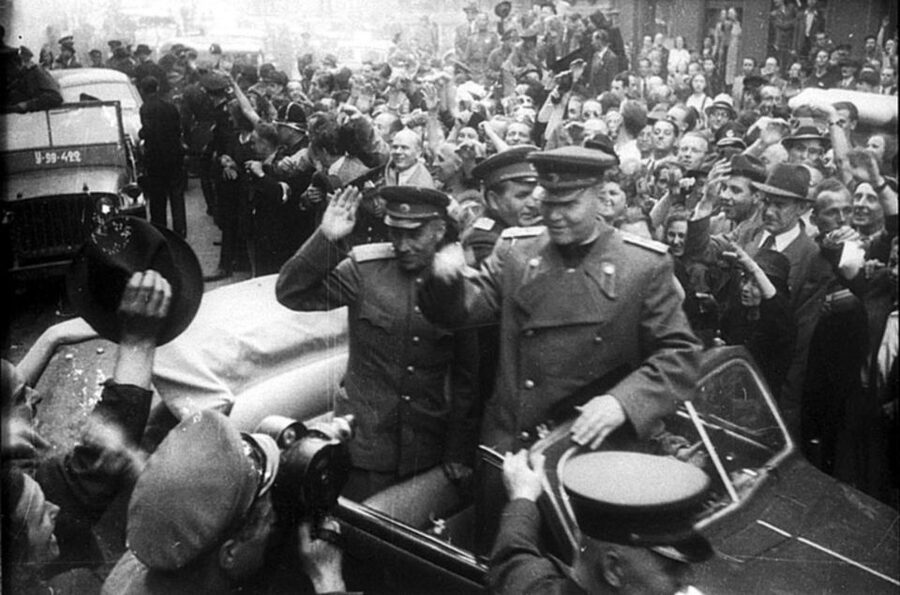
One especially important thread is the relationship between liberation and propaganda. The involvement of the Red Army in freeing the city was later used by the Czechoslovak Communist Party to increase support for communism. That’s a sharp idea, and it shows up again later in the tour.
Petschek Palace: where the resistance fought back against the Gestapo

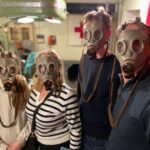
Next comes a stop that’s physically close to the public life of the city, but historically tied to fear. You walk to Petschek Palace, which served as the former seat of the Gestapo headquarters.
On the building you’ll find a memorial plaque dedicated to Czech resistance. Your guide explains the resistance efforts, including interrogations and tortures. This part of the tour is not about abstract evil. It’s about systems—who ran them and what resistance people risked.
What makes this stop hit harder is the contrast. You’re in central Prague where daily life continues. Yet the guide reminds you this was a place where ordinary people were caught in brutal policy. That’s the value of a walking tour like this: it forces you to reconcile beauty with what happened underneath.
Practical note for the setting: the tour is designed as a guided story walk, so the time at each exterior stop tends to be short but focused. That’s good, because the material stays moving without turning into a long lecture.
The 20th century left its mark here. More of that history, on foot.
Wenceslas Square: Nazi mass demonstrations and the Velvet Revolution
The tour ends where modern political emotion is easy to feel just by standing there: Wenceslas Square. This is one of Prague’s biggest stages, and the guide connects two eras of mass public messaging.
First, you learn about how the Nazis used Wenceslas Square for mass demonstrations. Then the story shifts to 1989 and the Velvet Revolution, when the mass demonstrations happened here as Czechoslovakia pushed for democracy and an end to authoritarian rule.
It’s also where the tour’s WWII-to-communism logic becomes more than a timeline. You start to see how public spaces can be used for different forms of control. Occupation used the square for intimidation and spectacle. The Velvet Revolution used it for collective political will.
By the time you reach the end point, you’ve walked through Josefov’s WWII persecution story, Old Town’s liberation fighting, and Petschek’s resistance reality. Ending at Wenceslas Square gives you a clean “before and after” feeling.
The 4-hour option: the Museum of Communism and the everyday machinery of control
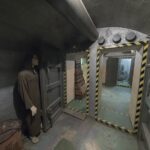
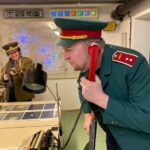
If you choose the extended 4-hour option, you add the Museum of Communism with regular tickets. This is where the tour turns from events to lived experience.
The museum covers the four decades of communist rule in Czechoslovakia and connects the Cold War era to specific crises. You’ll hear about the Prague Spring, the Soviet Invasion in 1968, and the suicide of student Jan Palach. You’ll also connect these events to the eventual push that led to the Velvet Revolution.
The museum content focuses on how a totalitarian regime shaped daily life and political power. Expect stories about propaganda, censorship, political trials, and executions. Those terms can sound like museum categories, but in the context of the tour route, they feel more personal. You’ve already seen where resistance operated and where control mechanisms sat in the city.
This option is the one to pick if you want more than a street-level overview. It’s also a good match if you like your history with explicit cause and effect: how propaganda built consent, how censorship limited truth, and how people responded when the system became impossible to live with.
Just be aware: the museum topics are intense. If you prefer lighter sightseeing, the Old Town portion might be enough for you.
Private guide quality: Sofija and Markéta set the tone
The strongest praise in the reviews is about the guides. Sofija is described as young but with immense knowledge, answering every question thrown her way and adding small anecdotes that made the history feel alive. Markéta is described as very entertaining and highly knowledgeable, with an engaging delivery.
That matters, because this tour covers different eras and different kinds of conflict. A good guide is what keeps the story coherent instead of turning into a list of tragedies. In practice, you’re looking for someone who can explain not just what happened, but how the pieces connect: Nazi occupation policies, Prague resistance, postwar political reshaping, and the eventual crack of communist rule.
In other words, the private format is not just about comfort. It’s about having enough time for a real back-and-forth, especially when the subject matter is complex.
Price, time, and value: what $104 gets you
At $104 per person, this tour sits in the midrange for a private, expert-guided history experience in central Prague. The value comes from two things.
First, you’re getting a structured route that links multiple key eras to concrete city sites, not a scattershot walk. You cover Josefov synagogues, Old Town Square and its WWII damage context, the Gestapo-linked Petschek Palace, and Wenceslas Square. That’s a lot of narrative territory for a 2-to-4-hour window.
Second, the 4-hour option adds the Museum of Communism with regular tickets. If you’re the kind of traveler who wants context for what you’re seeing—how propaganda worked, what life felt like, why specific events mattered—this extended choice can feel like the best deal of the two.
Is it expensive? It’s not cheap. But when you compare it to doing multiple separate visits with no deep threading between events, the private guided format is where the money makes sense.
Who should book this tour
This is a strong fit if:
- You want a history-heavy walk focused on WWII, occupation, resistance, and communism
- You like your sightseeing tied to specific locations—buildings, memorial plaques, and major squares
- You want an option that adds Museum of Communism for deeper context
It may be less ideal if:
- You prefer upbeat, light-day activities and minimal heavy topics
- You only want a quick highlights loop. The tour is designed for story and explanation, not just photo stops.
The tour is also available in multiple languages (English, French, German, Italian, Polish, Russian, Spanish, Czech) and is listed as wheelchair accessible, which helps if you need a more flexible format.
Should you book this WWII and Communism tour in Prague’s Old Town?
Yes—if you’re serious about understanding how Prague’s 20th-century history shaped the city you walk through today. I like that it doesn’t treat WWII and communism as separate chapters. It shows how liberation and political power got twisted together, and it ends where modern crowds made their choices.
If you’re on the fence between the two lengths, here’s a simple rule: choose the 2-hour tour if you want the street-side storyline and the key memorial sites. Choose the 4-hour tour if you want the bigger picture of how communism worked day to day, including major events like Prague Spring, the 1968 invasion, and Jan Palach.
FAQ
How long is the WWII and Communism History in Prague’s Old Town private tour?
It runs about 2 to 4 hours, depending on the option you select.
What’s included in the 2-hour option?
The 2-hour option includes a private WWII and communism-themed tour of Prague’s Old Town and the main memorial stops. Museum tickets are not included in this basic option.
What’s included in the 4-hour option?
The 4-hour option includes the Old Town tour plus a visit to the Museum of Communism with regular tickets.
Where does the tour meet?
Meet your guide in front of the World of Franz Kafka, Nám. Franze Kafky 16/1, 110 00 Staré Město, Czechia.
Is the tour private?
Yes, it’s a private group experience.
What languages are available for the guide?
The guide is available in English, French, German, Italian, Polish, Russian, Spanish, and Czech.
What parts of Prague does the tour cover?
The route includes walking through Josefov, stops around Old Town Square (including the Astronomical Clock area), a visit to Petschek Palace, and ends at Wenceslas Square.
Does the tour cover the Velvet Revolution?
Yes. The tour highlights the Velvet Revolution events at Wenceslas Square, and the Museum of Communism also covers it in the extended option.
Is the tour wheelchair accessible?
It’s listed as wheelchair accessible.
Can I cancel for a full refund?
Yes. The tour offers free cancellation up to 24 hours in advance for a full refund.
Would you like me to tailor the recommendation (2-hour vs 4-hour) based on your interests—WWII sites, communism history, or both equally?
More Private Tours of Prague
More Communism & Wartime History
The Old Town, A Few More Ways
More Prague tours we have written up lately



Old Town & Astronomical Clock, compared.
 ★ 4.3Oldtown, Medieval Underground & Dungeon History TourFrom $3110,277 reviews
 ★ 4.5Old Town Hall Tower Entry TicketFrom $216,749 reviews
 ★ 4.73-Hour Walking Tour of Old Town & Prague CastleFrom $305,696 reviews
 ★ 4.83-Hour Old Town and Prague Castle Tour in GermanFrom $365,671 reviews
 ★ 4.5Prague Old Town, Medieval Underground and Dungeon Historical TourFrom $323,227 reviews
 ★ 4.8Old Town and Jewish Quarter Guided Tour in GermanFrom $293,143 reviews
 ★ 4.5Ghosts and Legends of the Old Town Evening TourFrom $213,091 reviews
 ★ 4.6Old Town and Jewish Quarter Guided Walking TourFrom $222,847 reviews
Browse the lists this tour appears in