
REVIEW · PRAGUE WALKING TOURS
Best of Prague Private Walking Tour (Left and Right Riverbank)
Prague feels like a puzzle box, and this tour helps you solve it. You’ll get a relaxed, half-day introduction that links the left and right riverbanks with a licensed guide, so you’re not wandering blind through medieval streets. It’s also genuinely private, which means you can move at a human pace and ask questions without the usual herd-think.
What I like most is the combo of big-name sights and the small, story-driven stops that make the city click. I also love that guides often personalize the walk—one guide I heard about, Gabriela, mixed history with practical tips for beer and food, and another, Linda, was praised for pointing out lesser-seen details without dragging you through every corner forever.
One thing to consider is that this is still a walking tour with moderate fitness needed, plus Prague weather can turn fast. On rainy days, you’ll want a plan for wet shoes and slower photo stops, and your timeline may feel tighter than you expect.
In This Review
- Key highlights you’ll care about
- Entering Prague from the riverbanks (and why it works)
- Meeting at Náměstí Republiky: easy start, flexible finish
- Prague Castle: more than gates and viewpoints
- Malá Strana below the Castle: the quieter side of the river
- St. Nicholas Church and the Mozart organ myth
- Lennonova zeď: a wall of tribute, not just graffiti
- Charles Bridge: views, statues, and the St. John of Nepomuk legend
- The Klementinum: Jesuit roots and the National Library
- Pinkas Synagogue and the Old Jewish Cemetery entrance
- The Old-New Synagogue: Europe’s oldest working synagogue
- Old Town Square and the Astronomical Clock: the main stage
- Estates Theatre, Charles University (Karolinum), and Mozart’s Don Giovanni
- Wenceslas Square and the story behind the name
- Powder Gate (Prasná brána) and the Medieval Royal Route
- Municipal House (Obecní dům): a fitting ending near your starting area
- Price and value: what $134.23 buys you
- Practical advice to make your tour smoother
- Should you book this private left-and-right riverbank tour?
- FAQ
- Where does the tour start?
- Is hotel pickup included?
- How long is the walking tour?
- Is this a private tour?
- What language is the tour offered in?
- How much does it cost?
- Are admissions included?
- What’s the walking/fitness level?
- What if we have fewer people than expected?
- Can I cancel for a full refund?
Key highlights you’ll care about
- Riverbank route clarity that ties Malá Strana to Old Town without losing time to wrong turns
- Licensed private guiding with real personalities like Gabriela and Linda getting singled out
- A Lennon Wall story that explains why graffiti there is more than decoration
- Charles Bridge statue lore (including the St. John of Nepomuk legend)
- Jewish Quarter stops that add context around Holocaust memory
- Major “orientation” landmarks like the Astronomical Clock and Wenceslas Square
Prefer to cover it on foot? More Prague walks across the old lanes.
- Prague: 3-Hour Walking Tour of Old Town & Prague Castle★ 4.7 · 5,696 reviews
- Prague: Ghost Walking Tour Where Legends Come To Life★ 4.4 · 5,253 reviews
- Prague: Jewish Quarter Walking Tour with Admission Tickets★ 4.7 · 3,729 reviews
- Prague Guided Walking Tour and Cruise with Authentic Czech Lunch★ 5.0 · 3,627 reviews
Entering Prague from the riverbanks (and why it works)
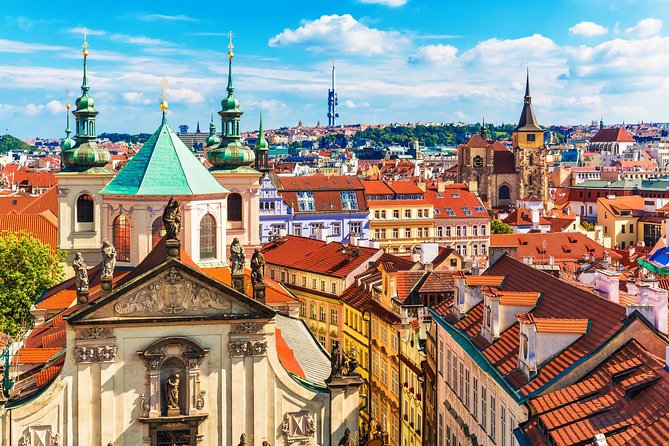
Prague is gorgeous, but it can also be disorienting. The streets loop. The hills hide views. And after a few hours, you can’t always tell whether you’re walking toward the river or just circling a block.
This tour fixes that with a smart flow: you start in the Old Town area and then work your way toward Prague Castle on the hill above, crossing through the spaces between. You get the sense of how Prague sits in layers—city center, castle hill, and the river corridors—without needing a map app open every five minutes.
The second reason I’m a fan is that it’s not just a checklist. A good private guide turns landmarks into a story you can remember. When you hear how the different districts evolved, the buildings stop feeling random.
Meeting at Náměstí Republiky: easy start, flexible finish
The meeting point is Náměstí Republiky 5 in Prague 1 (Staré Město). If you’re staying in the Old Town, you can also meet the guide at the entrance by the Municipal House, near the Gothic Powder Tower—handy if that’s where you’re already headed.
Pickup is offered from your hotel reception or outside your apartment building, and it’s described as pickup on foot (not a car). That matters because you’re not burning time on a vehicle route through traffic or trying to find a random curb spot.
One more practical detail: the tour can be shaped so you finish where you want. That’s useful if you’re planning an evening meal nearby or want to be close to a transit stop when you’re done.
Prague Castle: more than gates and viewpoints
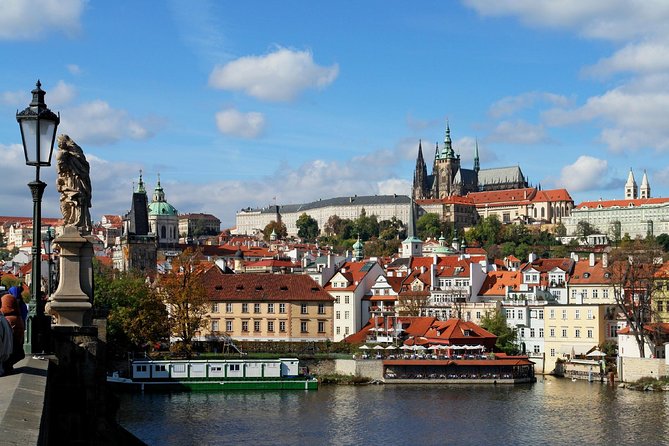
The Castle complex is the obvious anchor of any Prague visit, but the value here is how it’s presented. You’ll stand where the whole city’s drama is staged: a hilltop complex that has served as power center for centuries.
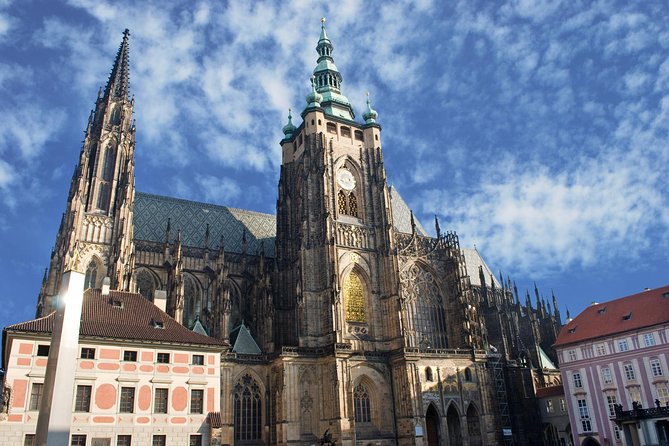
You’ll spend time at Prague Castle, with special attention to St. Vitus’ Cathedral. Expect the guide to connect the long construction timeline (it took around a thousand years) with the building’s Gothic feel and its role as the centerpiece. It’s also the setting for layers of political story—seat of the Czech president, linked to the Holy Roman Empire under Emperor Charles IV, and later associated with Adolf Hitler during darker chapters. You’ll also hear the names of postwar democratic leadership tied to the Castle: Tomáš G. Masaryk and Václav Havel.
What you can do with this stop: use it as your mental “north star.” After Prague Castle, the rest of the districts make more sense because you know where you are relative to the hill and why certain streets feel like they funnel you back toward the river.
One consideration: even if interior admission isn’t the focus, plan for crowds and big walking distances around the complex. Wear shoes that don’t punish you after hour one.
Malá Strana below the Castle: the quieter side of the river
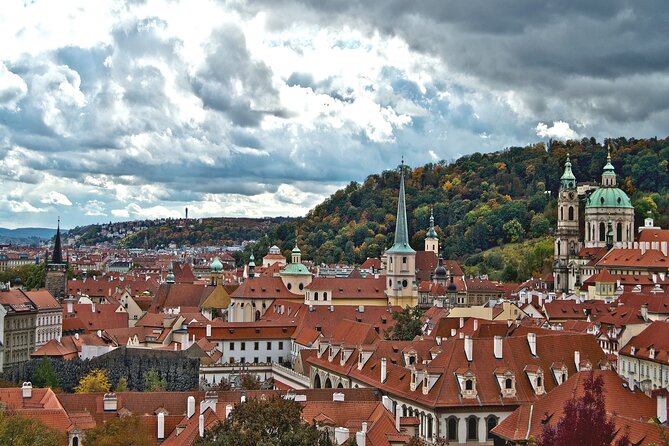
After the Castle area, the tour drops into Prague’s Lesser Town (Malá Strana). This district works best with guided framing, because it’s easy to see it as “pretty streets and palaces” without understanding why it looks like it does.
Here, you’ll hear about how the area began as small settlements outside the castle fortifications, with merchants invited by King Přemysl Otakar II and a population that included ethnic Germans. The story then turns through repeated damage from fires—1419 during Hussite battles and again in 1541—events that also affected St. Vitus’ Cathedral. That kind of context changes how you interpret what you’re seeing: buildings feel less like decoration and more like survival.
You’ll also pass sites connected to aristocratic-era Prague, including the Valdštejn (Wallenstein) palace area.
Practical tip: Malá Strana is scenic, but it also means more photo angles and slower wandering. If you want a tighter pace, tell your guide early and they can keep you moving through the best view points.
Rather have the guide to yourself? More private tours of Prague.

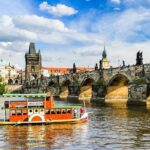
St. Nicholas Church and the Mozart organ myth
St. Nicholas Church is highlighted as a standout Baroque church in Malá Strana. If you’re into music history, the tour adds a great human detail: Mozart liked to practice on the organ here, mentioned as being helped by excellent acoustics.
Even if you don’t go deep into the interior, this stop is valuable because it gives your eyes a style “anchor.” Prague’s architecture swings between Gothic, Renaissance, and Baroque. When you see a dominant Baroque church after the Castle hill, the city’s variety becomes easier to spot.
Lennonova zeď: a wall of tribute, not just graffiti
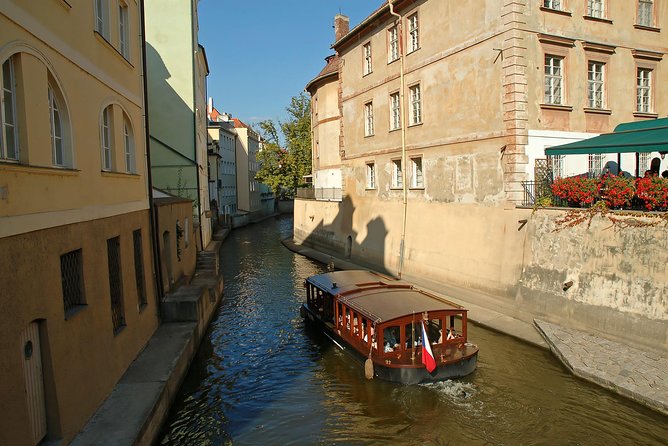
One of the most memorable short stops is Lennonova zeď, the long wall of John Lennon tribute graffiti near the river. Up close, it’s clearer what it’s for—today it’s a homage—but the tour context matters.
You’ll learn that graffiti appeared there during the Communist era, and that Western music was banned at the time. Fans risked imprisonment to show their admiration after Lennon’s death in 1980. The wall is also tied to the property of the Knights of the Maltese Cross, which adds another layer beyond the art itself.
This stop is short, but it’s one of the best examples of how Prague uses ordinary streets for historical meaning. It’s also a good “reset” moment in the middle of a busy walk.
Charles Bridge: views, statues, and the St. John of Nepomuk legend
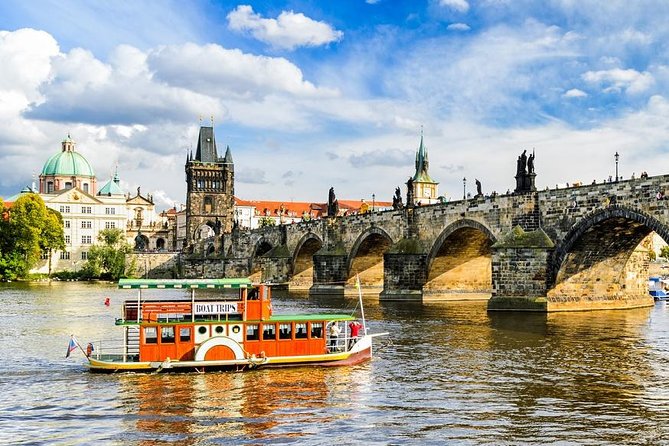
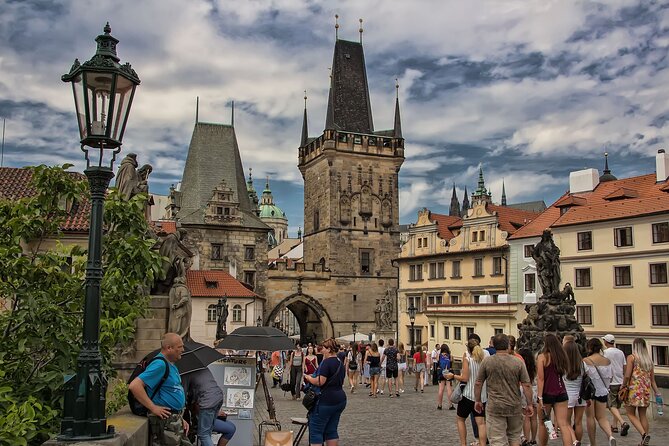
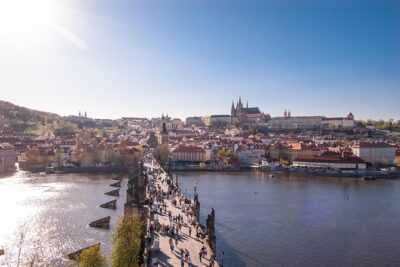
Charles Bridge is arguably Prague’s most iconic crossing, and you’ll get the big-picture reason fast: it links Old Town, the Lesser Town, and Prague Castle. It’s also a moving viewpoint—standing in the center of it gives you a postcard view that feels like the city arranged itself for you.
You’ll be guided through the details of the bridge’s Baroque statues—30 of them—added in the 18th century. A key note: many statues you see today are replicas, so the guide’s explanation helps you not get fooled by what’s “original” versus “today’s version.”
The story that really sticks is St. John of Nepomuk. The first statue erected on the bridge is said to be bronze, and the legend goes like this: he refused to reveal confessions of the wife of King Wenceslas IV and was thrown from the bridge to his death. Then five stars appeared in the sky, which is why you’ll notice a five-star halo in depictions of him.
If you’re going at a busy time, you’ll still want patience. The bridge is always a crowd magnet, but the guide’s pacing helps you catch good angles without feeling trapped.
The Klementinum: Jesuit roots and the National Library
A stop at the Klementinum brings the tour into the “Prague as a learning city” lane. It was founded as a Jesuit college and is home to the National Library. Even if you don’t go inside, the location helps you understand why Prague became influential beyond politics and cathedrals.
This is also a nice contrast point: after big public landmarks like the bridge, it’s more about institutions and what they meant to the city’s power and culture.
Pinkas Synagogue and the Old Jewish Cemetery entrance
The Jewish Quarter stops add weight to the half-day. You’ll visit Pinkas Synagogue, connected to the Jewish Museum. The walls are covered with names of Jews who perished during the Second World War, and the stop also provides entrance to the Old Jewish Cemetery.
The value here isn’t just seeing a synagogue building. It’s the way the tour frames remembrance as part of Prague’s street-level reality. This is a moment where your guide’s pacing matters; you don’t want constant hurry here.
Practical note: this area can feel quieter, so keep your voice down and give yourself a minute to absorb what’s in front of you.
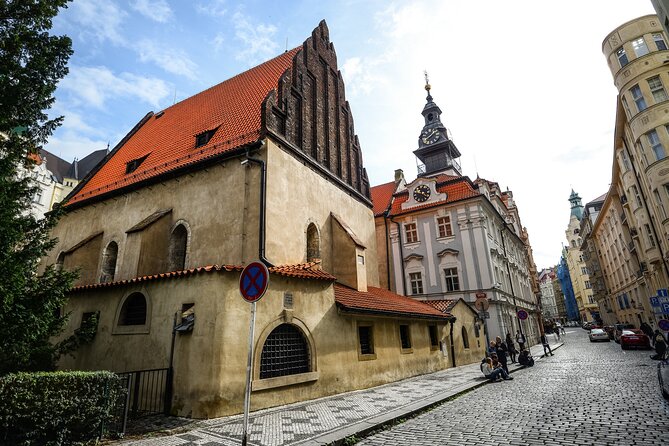
The Old-New Synagogue: Europe’s oldest working synagogue
Next up is the Old-New Synagogue, described as the oldest serving synagogue in Europe. It was completed in 1270 and built in a Gothic style, which is a fun contrast against the more “expected” synagogue look people come in expecting.
If you like architectural history, this stop helps you see that Prague’s religious life wasn’t stuck in one style or one era. It also helps you understand how old institutions stayed active through centuries of change.
This is also where I’d suggest you ask any history questions you care about. Because the tour is private, you can steer the conversation a bit—maybe toward how communities changed over time, or toward what to look for in the building’s design.
Old Town Square and the Astronomical Clock: the main stage
Old Town Square (Staroměstské náměstí) is the kind of place that makes you understand why guidebooks exist. Palaces and churches ring the square, and it’s tied to decisive events in the country.
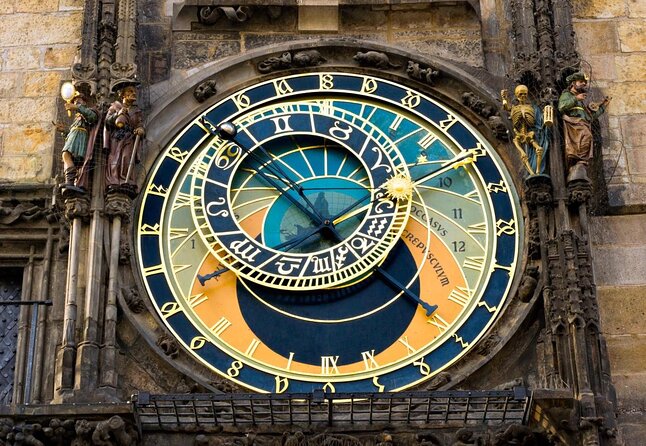
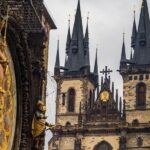
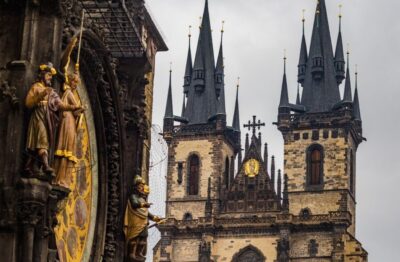
Then you’ll reach the Old Town Hall with the Astronomical Clock. The clock is famous for the hourly show—Death tips an hourglass and rings a bell, and the 12 apostles march by, with a cock crow and another bell in the mix. The guide will help you see it as a tradition, not just a mechanical spectacle.
This stop is great for first-timers because it sets the rhythm of Prague’s center. After this, you’ll know where the city’s “gravity” pulls you—whether you’re heading toward food, museums, or the next big square.
Estates Theatre, Charles University (Karolinum), and Mozart’s Don Giovanni
The Theatre Des Etats stop connects Prague to Wolfgang Amadeus Mozart. He visited Prague and chose the Estates Theatre for the world premiere of Don Giovanni, which he conducted himself in October 1787.
A few minutes later, you’ll reach Karolinum, part of Charles University. Charles IV founded the university in 1348. It’s described as the oldest university in the country and one of the oldest in Europe.
Together, these stops make the city feel like a place that generated culture, not just architecture. You also get a nice break from heavy stone and crowds, since the focus becomes ideas—music, performance, and learning.
Wenceslas Square and the story behind the name
Wenceslas Square sits in the New Town founded by Emperor Charles IV in 1348. It was originally called the Horse Market and became the stage for decisive events—especially the Velvet Revolution in 1989 that ended Communist rule.
This is a strong stop for people who want more than medieval vibes. It ties Prague’s past to the era most modern visitors recognize.
If your feet are feeling it at this point, this part of the walk is still worth slowing down for. Wenceslas Square is one of those places where the scale tells you something about the politics of the city.
Powder Gate (Prasná brána) and the Medieval Royal Route
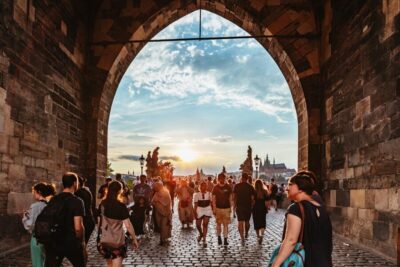
Prasna brana, the Powder Tower, is highlighted as a Gothic gateway to the Medieval Royal Route. It’s one of Prague’s iconic landmarks, and it works well as a visual wrap-up before the final stretch.
Even if you’ve seen it on photos already, seeing it in person helps you understand why it’s such a reference point for the city’s movements between districts.
Municipal House (Obecní dům): a fitting ending near your starting area
The Municipal House, Obecní dům, is used as a finishing point near the tour’s start area. It was built in 1912 at the site of the former Royal Court, and it was constructed to celebrate the Czech nation. You’ll hear about its notable concert hall and decoration as part of what makes it one of Prague’s architectural jewels.
Ending here is smart for practical reasons. You’re close to the area you started from, and it’s easier to link your next plan—dinner, a museum, or a relaxed transit ride—without crossing half the city on tired legs.
Price and value: what $134.23 buys you
At about $134.23 per person for roughly 3 hours 30 minutes, this is not the cheapest way to see Prague. But it’s also not trying to be.
For your money, you get a local, licensed guide, a private group experience, and a planned route that covers both riverbanks with a mix of major sights and meaningful stops. You also get pickup from your hotel reception or outside your apartment building (on foot), plus restaurant and shop recommendations and photo spots.
Here’s the real value angle: a good guide saves you from wasted time. Instead of spending your limited Prague hours figuring out which direction to walk next, you’re learning what matters and where to go next with confidence.
One small note: admission is not included, and you can pay on the spot by card if you want to go inside. That keeps the tour flexible. It also means your actual total cost can rise a bit if you decide to do every interior stop.
Practical advice to make your tour smoother
- Bring rain protection. One rainy day can turn “easy strolling” into a muddy slog fast.
- Wear shoes that handle uneven old streets and long standing at viewpoints.
- If you have strong preferences, tell your guide early. Some guides actively ask whether you want more history or a lighter tone, and that’s when the private format feels worth it.
- For getting around, I’d be careful with taxis in Prague. A practical tip shared in the information I received: ride-hail apps like Uber can be cheaper, while taxi cabs can be overpriced and unregulated.
Should you book this private left-and-right riverbank tour?
Book it if you’re trying to get your bearings fast and want Prague explained in a way that connects neighborhoods, not just monuments. The route—Castle hill down to Malá Strana, across Charles Bridge, through Old Town’s core, and back toward the Municipal House area—gives you a strong overview without feeling like you’re sprinting.
Skip it (or adjust your expectations) if you want lots of long museum interiors, or if you expect everything to be included and timed like a theme park. Admissions aren’t included, and it’s still a walking tour with a moderate fitness requirement.
If you want an efficient, story-driven first day in Prague—plus solid food and photo guidance—this one is a strong pick.
FAQ
Where does the tour start?
The meeting point is Náměstí Republiky 5, 111 21 Praha 1-Staré Město. There’s also an option to meet at the entrance to the Municipal House near the Gothic Powder Tower if you want to start in Old Town.
Is hotel pickup included?
Yes. Pickup is offered from your hotel reception or outside your apartment building. The description says it’s on foot, not by car, and you provide your address when booking.
How long is the walking tour?
It’s approximately 3 hours 30 minutes.
Is this a private tour?
Yes. It’s a private tour/activity, so only your group participates.
What language is the tour offered in?
The tour is offered in English.
How much does it cost?
The price is $134.23 per person.
Are admissions included?
No. Admission is not included. The guide notes that you can pay for admission on the spot by card.
What’s the walking/fitness level?
The tour lists a moderate physical fitness level, and you should be prepared to walk for the duration.
What if we have fewer people than expected?
A minimum of 2 people per booking is required.
Can I cancel for a full refund?
Yes. Free cancellation is available up to 24 hours in advance of the experience for a full refund.
More Sightseeing & Bus Tours





More Private Tours of Prague
On Foot Through Prague, Continued


More Prague tours we have written up lately



Prague Walking Tours, compared.
 ★ 4.73-Hour Walking Tour of Old Town & Prague CastleFrom $305,696 reviews
 ★ 4.4Ghost Walking Tour Where Legends Come To LifeFrom $275,253 reviews
 ★ 4.7Jewish Quarter Walking Tour with Admission TicketsFrom $763,729 reviews
 ★ 5.0Prague Guided Walking Tour and Cruise with Authentic Czech LunchFrom $1023,627 reviews
 ★ 4.6Old Town and Jewish Quarter Guided Walking TourFrom $222,847 reviews
 ★ 4.5Prague Ghost and Legend of Old Town Walking TourFrom $212,630 reviews
 ★ 5.0Prague 3-hour Afternoon Walking Tour including Prague CastleFrom $531,899 reviews
 ★ 4.7Ghosts and Legends Nighttime Guided Walking TourFrom $221,462 reviews
Browse the lists this tour appears in