
REVIEW · JEWISH QUARTER TOURS
Prague Synagogues and Jewish Quarter Private Walking Tour
This walk through Josefov can feel like stepping into a living museum of faith, law, art, and tragedy. What makes it especially interesting is how the route ties the Astronomical Clock area to the synagogues and cemetery in one smooth story line, with real time for questions.
I love that the tour is private and guided by a licensed local who can set the scene fast, including references to key figures and the way the community changed over centuries. I also like that the stops are practical: you see the synagogues you care about, plus the cemetery that explains why there are so few visible “top layers” of the past. One possible drawback is that the pace can be very stop-and-explain; if you want nonstop walking, this route may feel slower than you expect.
In This Review
- Quick Hits Before You Go
- Jewish Quarter Starts Right by the Astronomical Clock
- How Private Pickup Works for a 2.5-Hour Walk
- Josefov and the Jewish Museum: Your Timeline in a Small Area
- Maisel Synagogue: Philanthropy, Baths, and Community Building
- Pinkas Synagogue: Names Written for Nearly 80,000 Victims
- Old Jewish Cemetery: 12-Layer Graves and the Rabbi Loew Story
- Klausen and the Old-New Synagogue: Fire, Study, and Kafka’s Seat
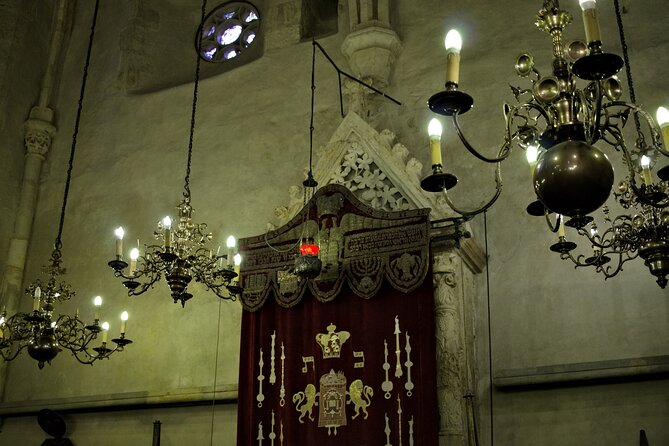
- Spanish Synagogue: Reform-Era Design and the Moorish Interior
- Pacing, Walking Distance, and Who This Tour Fits Best
- Price and Value for $175.24 Per Person
- Should You Book This Prague Synagogues Private Walk?
- FAQ
- Is the tour offered in English?
- How long is the Prague Synagogues and Jewish Quarter tour?
- Is this a private tour?
- Do you get hotel pickup?
- Are admission tickets included?
- What does the tour cost?
- Is a tip included?
- FAQ
- Can I get a refund if I cancel?
- What’s the tour cancellation cutoff?
- What’s included besides the guide?
- Where does the guide meet you?
Quick Hits Before You Go
- Private walking route through Josefov connects multiple synagogues without you playing “where do I go next?”
- Astronomical Clock to Jewish Quarter timing helps you start with one of Prague’s biggest landmarks and then move into history.
- Old Jewish Cemetery details you can’t easily guess (including layered tombs and the Rabbi Loew golem legend).
- Pinkas Synagogue memorial focus gives context for nearly 80,000 Jewish victims from the Czech lands.
- Golem-linked storytelling appears more than once (Rabbi Loew and the Old-New synagogue legend).
- Guide quality is a consistent highlight, with names like Gabriela, Janna, Hannah, and Hana mentioned for pace and humor.
Deeper into Josefov, and more of the Jewish Quarter synagogues.
- Prague: Jewish Quarter Walking Tour with Admission Tickets★ 4.7 · 3,729 reviews
- Prague: Old Town and Jewish Quarter Guided Tour in German★ 4.8 · 3,143 reviews
- Prague: Old Town and Jewish Quarter Guided Walking Tour★ 4.6 · 2,847 reviews
- Prague: Classical Concert in the Spanish Synagogue★ 4.7 · 1,104 reviews
Jewish Quarter Starts Right by the Astronomical Clock
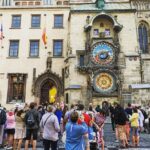
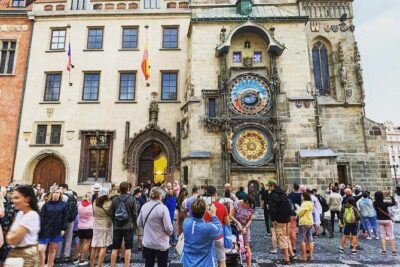
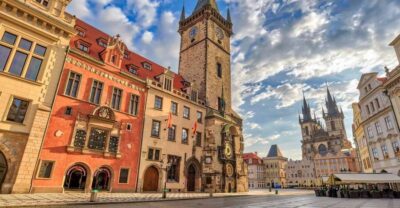
You begin near the Old Town Hall and Prague’s Astronomical Clock, then the guide brings you straight into Josefov, the historic Jewish Quarter. Starting here matters because it’s easy to see the contrast: the postcard square rhythm of Prague, and then the narrower streets that carry a very different emotional tone.
The first stop is short, about five minutes, and the goal is orientation. You meet under the Clock, then you’re off. After that, you have a full window to build context before you start walking synagogue-to-synagogue.
If you’re the type who likes to understand a place before you tour it, this opening is a big win. You’re not just collecting buildings. You’re learning how the Jewish community’s physical space in Prague changed over time.
How Private Pickup Works for a 2.5-Hour Walk
This is a private tour, so it’s built around your group only. That means you don’t get stuck waiting while a crowd shuffles through the same entrance in different languages. The downside of privacy is that you still move at “walking tour speed,” not “sit in a van speed.”
Pickup is offered at your hotel reception or outside your apartment building, or wherever you prefer inside the city center, but only on foot (not by car). You’ll provide your Prague address, and the guide meets you from there.
The timing is also practical: it runs about 2 hours 30 minutes. It’s long enough to cover a meaningful loop of Josefov, but short enough that you won’t feel trapped for an entire afternoon. Some of the synagogues take time because you’re expected to look carefully and ask questions.
A quick reality check: one account notes that in roughly three hours, the group walked about 1.7 miles, with lots of stops. So if your ideal day is fast and athletic, plan a lighter schedule before or after.
Josefov and the Jewish Museum: Your Timeline in a Small Area
The tour’s second stop is Josefov itself, where you get that “this area wasn’t erased” advantage. Josefov is considered one of the most important Jewish sights in the world partly because it was not destroyed during World War II. That fact shapes the whole visit: you’re seeing lived-in memory, not only ruins.
From here, the tour naturally points toward the Jewish Museum, which includes an old Jewish cemetery and multiple synagogues showing different angles of Jewish heritage: traditions, art, and history. Even before you step into individual synagogues, you start building a mental map of what each place is responsible for explaining.
This is also where a good guide earns their keep. The Jewish Quarter can feel overwhelming if you go in cold. With a guide, you learn what to look for first—so later, details at each synagogue land instead of floating past.
Maisel Synagogue: Philanthropy, Baths, and Community Building
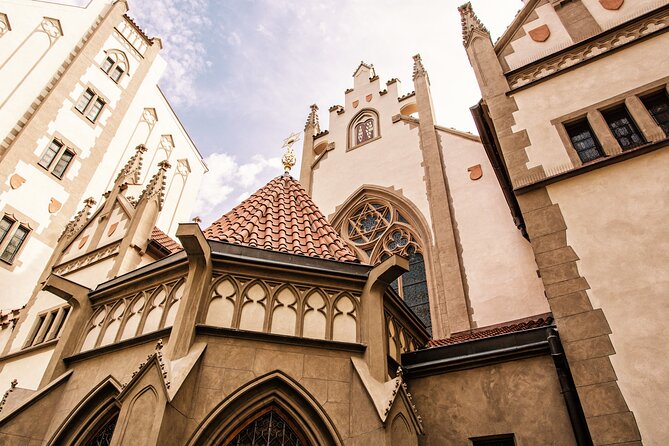
Next up is the Maisel Synagogue (built in 1592), named after Mordecai Maisel, a philanthropist who served as mayor of the Jewish town. You don’t just hear a date and move on. You learn how Maisel supported Jewish organizations and helped fund civic and community infrastructure.
A standout part of the story is how his donations connected religious life to practical needs: ritual baths, a public bathhouse, an almshouse, and support for communal institutions like the Jewish town hall and synagogues.
Why this stop matters: it pushes you away from the stereotype of the Jewish community as only “religion and prayer.” This place highlights governance, charity, and public services—how a community made daily life work.
The tradeoff is time. The visit is around 20 minutes, so you’ll want to ask questions that help you remember the bigger thread: how community leadership shaped the physical neighborhood.
Prefer to cover it on foot? More Prague walks across the old lanes.

Pinkas Synagogue: Names Written for Nearly 80,000 Victims
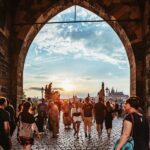
The Pinkas Synagogue (from 1535) is part of the Jewish Museum and functions as a memorial for nearly 80,000 Jewish victims of the Holocaust from the Czech lands. This stop is emotional, but it’s also specific—less fog, more facts.
If you’re traveling with someone who thinks history only happens in textbooks, Pinkas often changes their mind. The space and the memorial purpose make it harder to treat the subject as distant. The guide’s job here is balance: honoring the weight of the memorial while still keeping you oriented in how the synagogue is connected to the larger museum story.
Since this is one of the most solemn stops, I recommend you pace yourself. Take a beat, look longer than you think you need, then move on.
Old Jewish Cemetery: 12-Layer Graves and the Rabbi Loew Story
The Old Jewish Cemetery is one of the largest surviving ancient Jewish burial grounds in Europe and in the world, operating from the 15th century to the late 18th century. The scale is hard to grasp until someone puts it into numbers for you.
About 80,000 residents of the Prague ghetto were buried here. And because there wasn’t space for that many graves in a typical single layer, tombs were layered on top of each other. One part reaches 12 layers. That detail matters because it explains the physical reality of the cemetery, not just the legend.
Then comes the golem story—told here through Rabbi Judah Loew ben Bezalel. He’s known (in legend) for creating a mud figure, often described as a golem, said to have been summoned for protection against antisemitic attacks.
That blend—hard historical fact plus remembered legend—is part of why this stop works. You’re not just “looking at stones.” You’re seeing how community memory survived through both scholarship and story.
If you care about architecture and symbols, you’ll likely enjoy this part most. If you prefer lighter topics, you’ll still want to pause here because it gives meaning to the entire quarter.
Klausen and the Old-New Synagogue: Fire, Study, and Kafka’s Seat
At Klausen Synagogue, you get two big ingredients: size and origin. It’s described as the biggest synagogue in the Prague Jewish Town, and the name Klausen originally referred to three smaller 16th-century buildings on the site, including a yeshivah (Talmudic school) associated with Rabbi Loew.
Then you learn about the ghetto fire of 1689, and how Klausen was erected afterward in 1694 in the early Baroque style. So the building becomes a marker of both learning and survival.
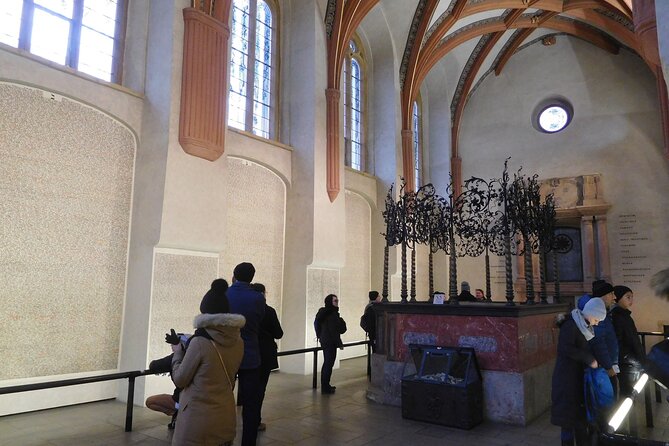
After Klausen, you visit the Old-New Synagogue, built in Gothic Cistercian style in the late 13th century. It’s considered the oldest building in the Jewish Town and one of the oldest synagogues in Europe still in use, serving as the main synagogue for more than 700 years.
Two details make this stop unforgettable:
- Franz Kafka attended services here.
- There’s legend that the golem is hidden in the attic.
Whether you treat legends as literal or as cultural meaning, the stories help you connect the dots between community identity, fear, learning, and the physical places where people gathered.
This is also where a guide’s storytelling pace really matters. If you move quickly through the synagogues, you’ll miss how each one supports a different part of the narrative.
Spanish Synagogue: Reform-Era Design and the Moorish Interior
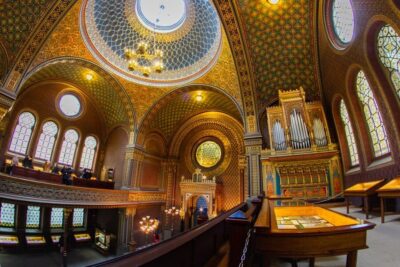
The Spanish Synagogue is the most recent synagogue on the route, built in 1868 for the local Reform congregation. It sits on the site of the earlier Altschul, a 12th-century synagogue noted as the oldest synagogue in the Prague ghetto.
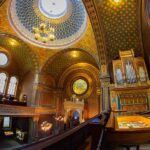
You’ll hear why it’s called the Spanish Synagogue: the interior has Moorish design, influenced by the famous Alhambra. In other words, this isn’t only about local continuity. It’s also about cultural aspiration and changing Jewish identity across time.
This stop is usually shorter—around 15 minutes—but it’s a nice tonal shift after the cemetery and memorial elements earlier in the loop. You’ll finish the main concentration of the tour with something visually distinct, which helps the emotional rhythm of the day.
Pacing, Walking Distance, and Who This Tour Fits Best
This is a walking tour, but it’s not a marathon. It’s a structured pause-and-interpret kind of route, where each stop gets time to breathe. One downside you should consider is that the style can feel slow if you’re used to tours that walk and talk continuously. In one description of a similar session, the group walked about 1.7 miles in around three hours, with frequent stop points.
So who is it best for?
- You like history that connects events to places you can still see.
- You want time to ask questions and get straight answers.
- You’re comfortable with a solemn tone at the memorial sites.
Who should be careful?
- If you struggle with frequent stops, standing in line, or uneven walking surfaces, plan ahead with your energy level.
- If you want a fast checklist tour, you may feel this version is more thoughtful than speedy.
The good news: because it’s private, your guide can often tailor the rhythm to your group’s needs better than a big shared tour would.
Price and Value for $175.24 Per Person
At $175.24 per person, this isn’t a budget add-on. But it also isn’t overpriced for what you actually get: a private guided walk, multiple synagogue visits across Josefov, and Jewish Museum tickets included as part of the package.
One thing to note is that the stop-by-stop details label some synagogue admissions as not included, while the package includes Jewish Museum tickets. That tells me you should verify what your confirmation covers for the specific entries you plan to see. Still, the pricing structure signals that you’re not paying extra at every stop for the core museum-linked sites.
You also get hotel-area pickup on foot (no car ride cost), plus a mobile ticket. The inclusion of a regular charity support element for local children’s homes is another small value detail—it doesn’t change the route, but it’s part of the overall package.
Finally, this tour is often booked about 72 days in advance, so treat it like a popular slot and reserve earlier if your dates are fixed.
Should You Book This Prague Synagogues Private Walk?
Book it if you want a guided Josefov route that ties the synagogues and cemetery into one clear story, with enough time to ask questions and not feel rushed. The repeated praise for guides like Gabriela, Janna, Hannah, and Hana comes down to the same things that matter in real life: pacing, care, and making sure you see what’s open before closing.
Skip or reconsider if your priority is nonstop walking or if you need a faster-moving itinerary. This tour is built for interpretation, not sprinting.
If you’re deciding, here’s my practical rule: if you’re the kind of person who reads plaques and asks why something is here, you’ll likely love this. If you mostly want quick photos and minimal standing, choose a shorter route.
FAQ
Is the tour offered in English?
Yes. The tour is offered in English.
How long is the Prague Synagogues and Jewish Quarter tour?
It lasts about 2 hours 30 minutes.
Is this a private tour?
Yes. It’s a private experience, meaning only your group participates.
Do you get hotel pickup?
Pickup is available at your hotel reception or outside your apartment building or wherever you prefer in the city center, but only on foot (not by car). You should provide your Prague address.
Are admission tickets included?
The package includes Jewish Museum tickets, and the itinerary notes that some stops are free while others may require entry. Check your confirmation for what’s covered for each synagogue stop.
What does the tour cost?
The price is $175.24 per person.
Is a tip included?
No. Tip is not included.
FAQ
Can I get a refund if I cancel?
Yes, with free cancellation. You can cancel up to 24 hours in advance for a full refund.
What’s the tour cancellation cutoff?
The cutoff is based on the experience’s local time.
What’s included besides the guide?
Included items are a local licensed guide, pickup on foot, Jewish Museum tickets, and regular support for local children’s homes.
Where does the guide meet you?
The guide can meet you at your hotel reception or outside your apartment building, or another preferred location in the city center on foot.
More Private Tours of Prague

On Foot Through Prague, Continued
Keep Exploring the Jewish Quarter


More Prague tours we have written up lately


Jewish Quarter Tours, compared.
 ★ 4.7Jewish Quarter Walking Tour with Admission TicketsFrom $763,729 reviews
 ★ 4.8Old Town and Jewish Quarter Guided Tour in GermanFrom $293,143 reviews
 ★ 4.6Old Town and Jewish Quarter Guided Walking TourFrom $222,847 reviews
 ★ 4.7Classical Concert in the Spanish SynagogueFrom $501,104 reviews
 ★ 5.0Prague’s TOP Sights – Old Town, Jewish Quarter, Charles Bridge (Tip-based tour)From $3843 reviews
 ★ 5.0Prague Old Town New Town and Jewish Quarter Morning TourFrom $32757 reviews
 ★ 4.2Old Town, Jewish Quarter & Astro Clock Walking TourFrom $22552 reviews
Browse the lists this tour appears in