
REVIEW · PRAGUE WALKING TOURS
Walking tour of Prague in French : Nové Město
Prague’s Nové Město tells a clear story. This French walking tour walks you through 14th-century urban planning and the riverfront area along the Vltava. I like that you get both architecture and culture, not just photo stops, and I also like the pace: 2.5 hours that feels like a guided orientation for the city. One thing to consider is the language: it’s French all the way, so you’ll want basic understanding or rely on visuals.
You’ll spend your time moving through a district planned in the 1300s and later layered with major Czech cultural landmarks. Expect a guide who keeps explanations interesting and readable, with French service led by a live, licensed professional, and in past feedback the guide Alexandre gets singled out for captivating explanations. The main drawback is simply walking time: it’s rain, shine, or snow, so dress for the weather and keep footwear comfortable.
In This Review
- Key things to know before you go
- Nové Město’s 14th-century plan in plain sight
- Getting to Jindřišská věž: your easiest arrival plan
- Senovážné náměstí, Na Příkopě, and Náměstí Republiky: the squares that explain the city
- Ovocný trh, Václavské náměstí, and Jungmann Square: the feel of the “horses market”
- Franciscan Gardens, David Černý sculpture, and the “modern Prague” cues
- Down toward the Vltava: Masarykovo nábřeží, the Legion Bridge, and Archer’s Island
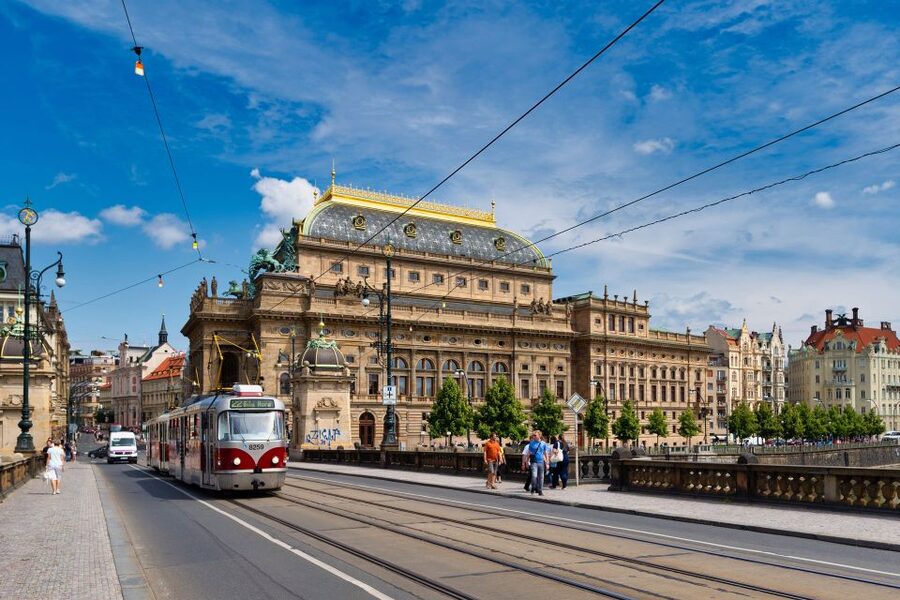
- Powder Tower, Estates Theatre, National Renaissance landmarks, and the National Theatre focus
- Price and pacing: is $27 worth it?
- Should you book the Nové Město French walking tour?
- FAQ
- What language is the walking tour in?
- How long is the Prague Nové Město walking tour?
- Where do I meet the guide?
- Is there public transport to the meeting point?
- What is included in the price?
- What is not included?
- What happens if the weather is bad?
- What is the cancellation and reserve option?
Key things to know before you go
- French-only live guide: plan on listening and following the narrative in French.
- Nové Město’s “three markets” plan: you’ll connect squares to Charles IV’s 1348 vision.
- Architecture across eras: Gothic, Baroque, Art Nouveau, Cubist, and National Renaissance show up in what you’re seeing.
- River walk moments: you’ll cover stretches by the Vltava quays and Archer’s Island area for better photo angles.
- Value for 2.5 hours: a licensed local guide plus advice for your stay is included in the ticket price.
Prefer to cover it on foot? More Prague walks across the old lanes.
- Prague: 3-Hour Walking Tour of Old Town & Prague Castle★ 4.7 · 5,696 reviews
- Prague: Ghost Walking Tour Where Legends Come To Life★ 4.4 · 5,253 reviews
- Prague: Jewish Quarter Walking Tour with Admission Tickets★ 4.7 · 3,729 reviews
- Prague Guided Walking Tour and Cruise with Authentic Czech Lunch★ 5.0 · 3,627 reviews
Nové Město’s 14th-century plan in plain sight
The big idea behind this walk is that Prague’s New Town was not random sprawl. It was laid out in 1348 under Charles IV, with urban life organized around three central markets. Your guide turns that into a simple map you can remember: the cattle market at Charles Square, the horses market at Wenceslas Square, and the hay market at Senovážné Square. Once you understand that, the squares stop feeling like separate stops and start feeling like a functioning plan.
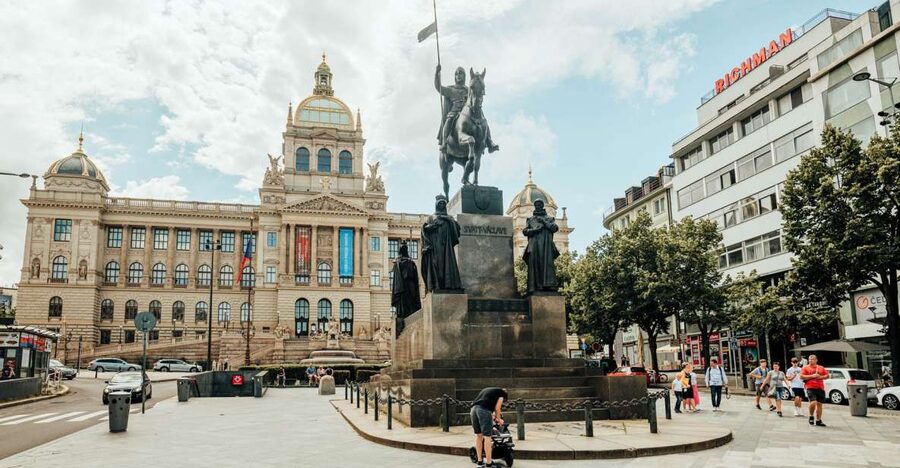
What I find especially useful is how the tour links street space to Czech identity. The district is where you’ll also hear about major cultural milestones tied to the Czech National Renaissance, including big institutions such as the National Museum and National Theatre and their role as a precursor of the Czechoslovak independence of 1918. It’s not a museum lecture. It’s a walking context that makes the city’s buildings feel like they belong to a timeline you can place.
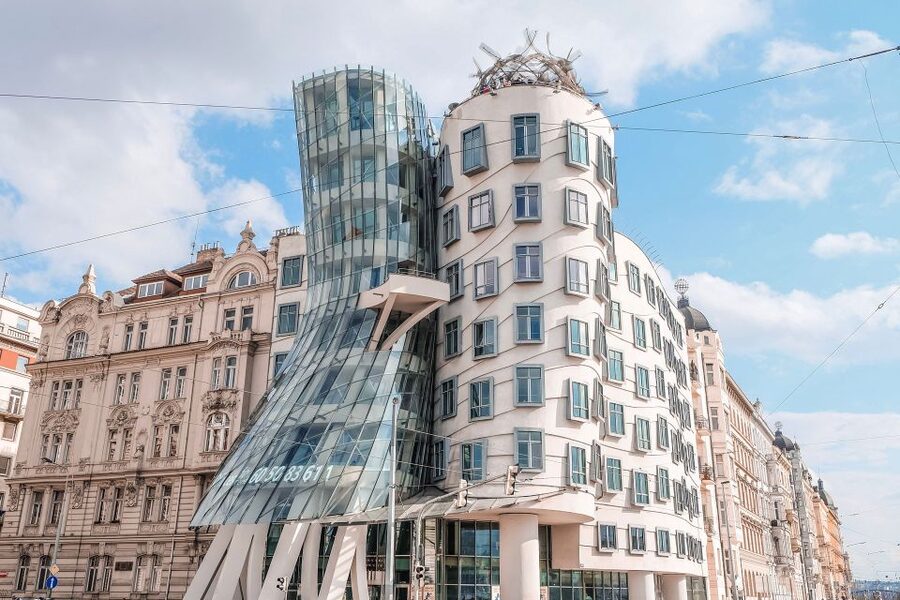
The tour also acknowledges more recent Prague moments, like the Prague Spring, and you’ll get hints of modern architecture too, including the famous House Who Dances. That mix matters: it shows you how the city kept evolving without losing the original skeleton.
Getting to Jindřišská věž: your easiest arrival plan
The meeting point is in front of the entrance of Jindřišská Tower. If you want the low-effort route, take the tram from Jindřišská station, served by lines 3, 5, 6, 9, 14, and 24. That’s handy because it gives you a clear “Plan A” that doesn’t depend on walking long distances from farther areas.
For timing, the tour runs about 2.5 hours, and starting times depend on availability. I’d treat it like a first or mid-day activity: you’ll get way more out of it if you’re not exhausted, because your guide will connect what you see to the story behind it.
Senovážné náměstí, Na Příkopě, and Náměstí Republiky: the squares that explain the city
Your early portion starts strong with the sense of direction. After beginning at Jindřišská Tower, you move to Senovážné náměstí for about 10 minutes of guidance. This is where the tour’s “three centralities” concept really clicks, because Senovážné Square is tied to the hay market idea. Even if you don’t care about medieval economics, this framing helps you read the city like a layout, not just a postcard.
From there you continue to Na Příkopě 864 and then to Náměstí Republiky (about 15 minutes). This is a good stretch for understanding architectural variety. The tour points out works spanning Gothic, Baroque, Art Nouveau, and Cubist styles, and these central areas are where you can notice how the city looks layered rather than uniform.
Practical tip: these stops are short and frequent. Your best move is to let the guide lead, then use your own eyes to confirm what you’re hearing. If you’re the type who reads every plaque, you’ll likely want to pause later on your own, because the guided time is about orientation.
Ovocný trh, Václavské náměstí, and Jungmann Square: the feel of the “horses market”
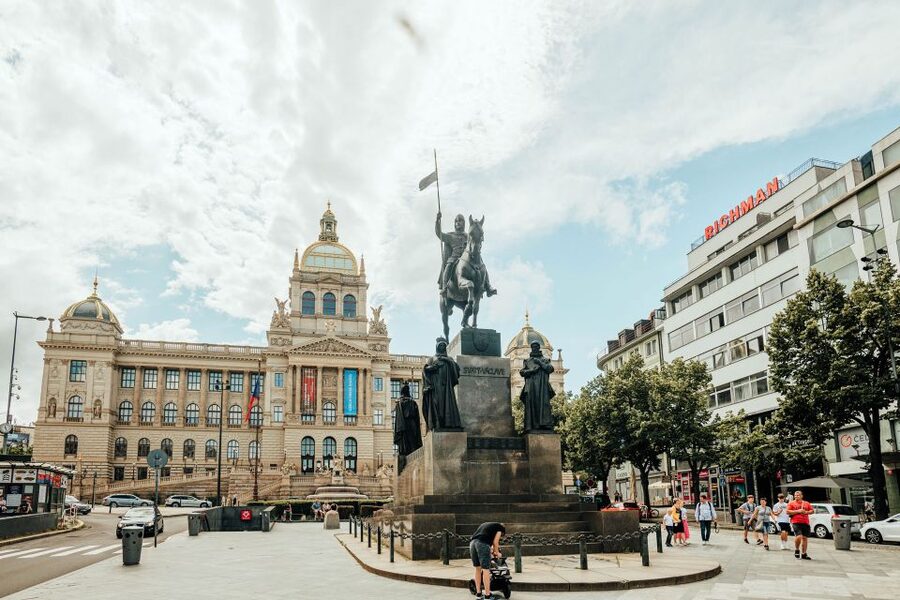
Next comes a string of classic New Town neighborhoods and squares: Ovocný trh, Václavské náměstí (Wenceslas Square), and Jungmann Square. The time here is spread out into manageable segments, with multiple guided stops around 10 minutes each. This matters because these areas can get busy on your own. With a guide, you get a clearer route and more meaningful takeaways.
Wenceslas Square is the horses market centerpiece in the tour’s framing, which gives you a simple reason to focus on what’s around you. You’ll also hear about how Prague’s monumental identity shows up in the urban fabric, not just in isolated landmarks. Expect the guide to connect the square’s importance to the wider story of Prague’s growth.
What I like here is the photography angle. Even without a single “must-shoot” viewpoint, repeated stops in open squares and streets help you build a photo set that feels coherent. If you’re traveling with a camera or phone, this is the part where you can get your angles dialed in before you head toward the river.
Keep walking. More of Prague at street level.



Franciscan Gardens, David Černý sculpture, and the “modern Prague” cues
Around Franciscan Gardens you get a different kind of atmosphere. The guided time is about 10 minutes, and it’s a good place to slow down for a moment. Gardens are useful on a walking tour because they reset your senses, and they can give you better sight lines for building details you’d miss while moving quickly.
Then you hit a quick stop for the David Černý sculpture area, guided for about 5 minutes. This is one of those brief breaks that can still change how you look at the city. Czech contemporary art has a reputation for cleverness, and even in a short moment you’ll get the point: Prague isn’t frozen in the past.
Right after, you return to the big square energy again at Wenceslas Square, and then you keep moving along nearby streets such as Sokolská 1595/62 and Na Rybníčku (each guided briefly). These quick stops are often where guides work best: they point out building-level details and explain why a small location matters to the bigger story.
Down toward the Vltava: Masarykovo nábřeží, the Legion Bridge, and Archer’s Island
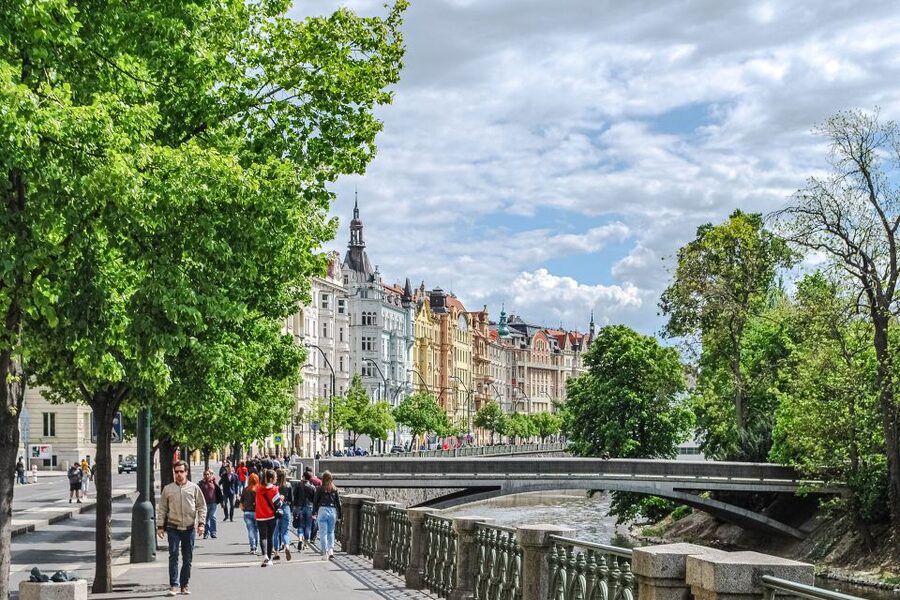
This is where the tour shifts from “reading the city streets” to “walking the city edge.” You’ll go along Masarykovo nábřeží for a short guided moment and then toward Legion Bridge (about 5 minutes). From the highlights, you’ll also walk by the quays of the Vltava and on Archer’s Island, which is a key reason this tour earns its keep. River walks in Prague tend to reward you with spacing, views, and different angles on the skyline.
Legií Park is the next stop and guided time is about 10 minutes. This part of the route is helpful if you want a break from stone façades and square-to-square walking. You also get natural photo opportunities because the river edge creates a different kind of framing than the streets do.
Here’s the practical advice: keep an eye on your footing on river paths, and plan for wind. If it’s cold or rainy, this is the segment most likely to feel it.
Powder Tower, Estates Theatre, National Renaissance landmarks, and the National Theatre focus
Even if the itinerary keeps moving with lots of short guided stops, the tour’s landmarks are consistent with the theme: major buildings that represent Czech national identity and changing architectural tastes. You’ll hear about iconic sites such as the Powder Tower, the Estates Theatre, the Municipal House, and the House of the Black Madonna, plus major Czech National Renaissance anchors like the National Museum and National Theatre.
The most explicit cultural anchor late in the walk is the Prague National Theatre, with about 10 minutes of guided attention. This is a valuable stop because the tour treats it as more than a pretty building. The idea is to connect national renaissance architecture to the sense of identity and independence that reached a turning point around 1918.
If you’re thinking about your day plan, this is also a good moment to look ahead. After seeing how the National Theatre sits in the story, you’ll understand why Prague’s “grand buildings” feel meaningful rather than decorative.
Price and pacing: is $27 worth it?
At $27 per person for roughly 2.5 hours, I’d call this good value, mainly because what you’re paying for is not just “someone pointing at things.” You’re getting a local guide licensed by the Czech Ministry of Tourism, live French narration, and structured explanations tied to history and Czech culture. You also receive “good addresses” and advice for your stay, which can be worth more than it sounds if it helps you plan meals or your next sightseeing step.
The pacing is also smart. Many stops are 5 to 15 minutes, which prevents the classic walking-tour problem of one long lecture where your attention fades. If you like to take photos, the frequent “reset” points help you look, listen, and reframe your camera.
Two practical considerations to keep in mind:
- It runs in rain, shine, or snow, so your comfort depends on clothing and shoes.
- It doesn’t include transport tickets, hotel pickup/return, or food and drinks, so you’ll want to budget for tram/metro and a café stop after.
One final note on quality: the tour rating is 4.9 with 16 reviews, and the standout praise is consistent. People call out explanations that feel interesting and captivating, and the overall experience as simply perfect. That’s the kind of feedback that usually means your guide will keep the story clear.
Should you book the Nové Město French walking tour?
Book it if you want Prague with structure. This tour is built around a clear theme (Nové Město’s 14th-century planning and its later cultural layers), and the route mixes squares, architecture, and the riverfront in a way that helps you actually remember what you saw.
Skip it or think twice if French is a stretch for you. Since the tour is French only, you’ll lose some of the nuance if you can’t follow the narration.
Overall, I’d recommend it as a first-time or second-visit activity in Prague because it gives you orientation and meaning at the same time. If you like cities where history shows up in the streets, not just in monuments, this one fits.
FAQ
What language is the walking tour in?
The tour is in French, led by a live tour guide.
How long is the Prague Nové Město walking tour?
The duration is approximately 2.5 hours. Starting times depend on availability.
Where do I meet the guide?
Meet in front of the entrance of Jindřišská Tower.
Is there public transport to the meeting point?
Yes. The easiest way is by tram from Jindřišská station, served by lines 3, 5, 6, 9, 14, and 24.
What is included in the price?
Included are a licensed local guide, the approximately 2.5-hour guided walking tour in French, explanations about the sites and Czech culture, plus good addresses, advice for your stay, and a good mood.
What is not included?
Not included are pick-up and return to your hotel, transport tickets, and food and drinks.
What happens if the weather is bad?
The tour runs in rain, shine, or snow.
What is the cancellation and reserve option?
You can cancel up to 24 hours in advance for a full refund. You can also reserve now and pay later.
More Tours in Prague


More Tour Reviews in Prague



On Foot Through Prague, Continued

More Prague tours we have written up lately



Prague Walking Tours, compared.
 ★ 4.73-Hour Walking Tour of Old Town & Prague CastleFrom $305,696 reviews
 ★ 4.4Ghost Walking Tour Where Legends Come To LifeFrom $275,253 reviews
 ★ 4.7Jewish Quarter Walking Tour with Admission TicketsFrom $763,729 reviews
 ★ 5.0Prague Guided Walking Tour and Cruise with Authentic Czech LunchFrom $1023,627 reviews
 ★ 4.6Old Town and Jewish Quarter Guided Walking TourFrom $222,847 reviews
 ★ 4.5Prague Ghost and Legend of Old Town Walking TourFrom $212,630 reviews
 ★ 5.0Prague 3-hour Afternoon Walking Tour including Prague CastleFrom $531,899 reviews
 ★ 4.7Ghosts and Legends Nighttime Guided Walking TourFrom $221,462 reviews
Browse the lists this tour appears in