
REVIEW · OLD TOWN & ASTRONOMICAL CLOCK
Secrets of Prague Old Town: Self-Guided Puzzle Walk
Prague becomes a puzzle walk. I love the offline mobile clues that keep you moving without waiting on a guide, and I love how the route strings together big-name churches, bridges, and viewpoints in about two hours. The one possible downside: the story layer is light, so if you want wall-to-wall narration, you may wish there were more explanation.
The format is also great for pacing. You can take breaks, shop, and grab a drink whenever you want, because it’s made to run on your schedule. Just know you’ll do real walking (and a few stair climbs), so plan for comfy shoes.
In This Review
- Key things I’d focus on before you go
- How the self-guided puzzle game moves you through Prague
- Wenceslas Square: your first clue, and a place with a pulse
- Church of Our Lady of the Snows: Gothic ambition, interrupted
- Church of Our Lady before Týn: twin towers, key details, and an organ worth pausing for
- St. Giles Church: Mozart’s wedding and Czech sculptor Ferdinand Brokoff
- St. Martin in the Wall: the two-kinds sacrament and why the name stuck
- Iron Knight: a cursed legend tied to Prague City Hall
- The Clementinum and Vlašská chapel: Italian oval shapes in a Jesuit world
- Old Town Bridge Tower and the coronation route you can trace on foot
- St. Nicholas Church and the 215-step view: Prague rewards you for climbing
- Prague Castle: the final push, Wrestling Titans, and changing guards
- Old Town Hall and the Astronomical Clock’s legend
- Lesser Town Bridge Tower: ravens, a missing stone, and a knight’s fate
- Is the $7.21 puzzle walk worth booking?
- FAQ
- FAQ
- How long is this Prague puzzle walk?
- Where does the route start and end?
- Is it really self-guided, or do I meet a tour guide?
- Do I need an internet connection?
- What language is it offered in?
- Are entrance tickets included for the sights?
- Can I start at any time?
- What if I need to cancel?
Key things I’d focus on before you go
- Offline-first navigation: you don’t need internet once the game is loaded.
- Private, no-human-contact feel: it’s just you and your group, with no meeting a guide.
- A tight Old Town to Castle route: the sightseeing flow makes sense on foot.
- Puzzle clues at every stop: you’re not just reading plaques, you’re solving.
- Lots of free entries: most sights are marked free, with one paid segment at the Astronomical Clock.
- Good value at $7.21 per person: especially if you like exploring in your own rhythm.
Still circling the Old Town? More of the square and its lanes, reviewed.
- Prague: Oldtown, Medieval Underground & Dungeon History Tour★ 4.3 · 10,277 reviews
- Prague: Old Town Hall Tower Entry Ticket★ 4.5 · 6,749 reviews
- Prague: 3-Hour Walking Tour of Old Town & Prague Castle★ 4.7 · 5,696 reviews
- Prague: 3-Hour Old Town and Prague Castle Tour in German★ 4.8 · 5,671 reviews
How the self-guided puzzle game moves you through Prague
This isn’t a guided walking tour with one person talking over the crowd. It’s a self-guided quest built around clues and short puzzles. You follow hints from stop to stop, and at each location you get the next instruction once you figure out the answer.
For planning, the big practical win is flexibility. You can start at any time during the day, and you can pause and resume later. That means you’re not stuck with the classic group-tour problem: everyone waiting on the slowest person (or the slowest person waiting on everyone). You’re also working with a mobile ticket, so you’re not hunting for paper vouchers.
Language is English, and it’s a private setup, meaning only your group plays. If you want a “see a lot without crowds” approach, this is built for that.
Wenceslas Square: your first clue, and a place with a pulse
You start on Wenceslas Square (Václavské náměstí), which feels more like a long boulevard than a single scenic square. It’s about 750 meters long, and historically it functioned as a horse market. That old, practical purpose matters because it reminds you this street wasn’t designed only for postcards.
The area also reads like a timeline of Czech modern history. You’ll connect it to national celebrations, the 1968 moment when Soviet tanks entered, and the 1989 protests that helped shift the country’s future. Then the mood changes again: today it’s Prague’s entertainment and nightlife zone, with shops, restaurants, cinemas, and clubs.
Clue-wise, you’ll find instruction markers around the square area. If you climb to the National Museum, you get a classic sweeping view down the boulevard. And near the St. Wenceslas statue, there are two ground plaques honoring victims of the communist regime, including Jan Palach, who set himself on fire in protest during the Soviet invasion. It’s a heavy detail, but it makes the “game start” feel grounded in real places, not just decoration.
Church of Our Lady of the Snows: Gothic ambition, interrupted
Next you head to the Church of Our Lady of the Snows, a project tied to King Charles IV’s grand plans. The idea was a Gothic church connected to a Carmelite monastery, meant to be nearly second only to Prague’s main cathedral in size and height. The Hussite Wars stopped that plan in its tracks, so what you see is incomplete—but what remains is still impressive.
The standout is the vault: 34 meters high, the tallest vault in Prague. Even if you don’t study architecture deeply, you’ll feel that scale when you’re standing nearby. Early 17th-century Franciscan monks took over the abandoned complex under Emperor Rudolph II and added a surrounding Baroque monastery and library.
Right next to the complex, take time for the Franciscan Gardens. They give you a view over the church’s Gothic vaulting, which turns into one of those “how did they hide this in plain sight?” moments.
Church of Our Lady before Týn: twin towers, key details, and an organ worth pausing for
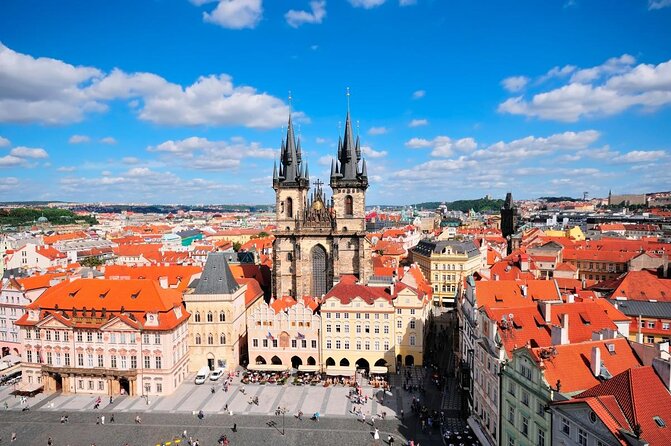
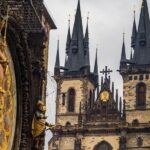
Now you’re at Church of Our Lady before Týn, the Gothic cathedral known for its twin towers and the Madonna statue placed between them. One tower is more solid than the other, which is a small detail most people never notice—until you’re looking for it.
Inside, you’ll find several reasons to slow down. The church houses a valued organ from the second half of the 17th century. You can also walk among medieval, Gothic, and Baroque tombstones, which makes the floor feel like a layered record of Prague’s past.
There’s also a challenge here tied to a historical figure buried near the main altar. You’ll learn the name once you solve the puzzle at this location. That’s a nice trick: you get specific context instead of generic “this is old” sightseeing.
One practical note: if you’re traveling at peak hours, this stop can feel busy. Still, the game structure gives you a way to keep your momentum, even when the church interior is crowded.
Keep walking. More of Prague at street level.

St. Giles Church: Mozart’s wedding and Czech sculptor Ferdinand Brokoff
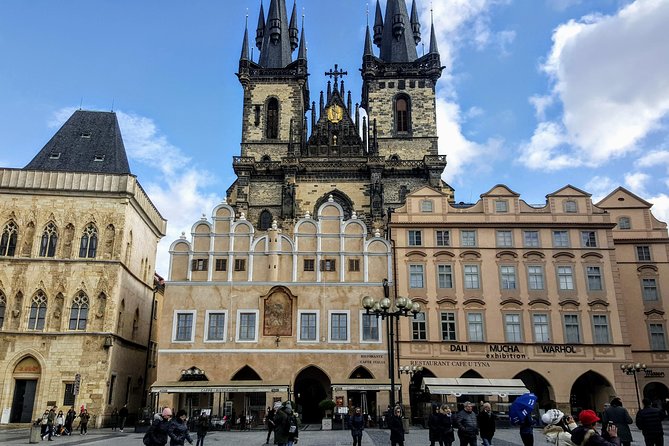
Next up is St. Giles Church (in the Old Town Dominican monastery complex). This building adds a layer of time travel: it’s originally Romanesque, later rebuilt in Gothic style.
This is one of those stops where the facts are fun enough that you might forget you’re supposed to be solving puzzles. For example, Mozart and Constanze got married here. That detail alone gives the church personality, not just age.
Look for the rich stucco decorations and the frescoes on the vaults. There’s also an Altar of the Painful Virgin Mary, and you’ll likely notice the statues of apostles. The apostles are the work of Czech sculptor Ferdinand Maxmilian Brokoff, which makes this a great stop for anyone who likes connecting names to art.
Music fans have an extra reason to linger: there are concerts of classical and religious music. Even if you’re not catching a concert, the setting makes you understand why this church is used for performances.
St. Martin in the Wall: the two-kinds sacrament and why the name stuck
Then the route heads to St. Martin in the Wall Church. This one has a “how did it end up like this?” feeling. It began in the Romanesque style in the settlement of Ujezd, but Charles IV pushed for Gothic rebuilding.
In 1414, it’s noted as the first time the sacrament was given in two kinds: bread and wine in a cup. Before that, it belonged only to priests. That small line is a big change in everyday religious practice, and it explains why the site matters beyond just architecture.
In the 18th century, the church was canceled and turned into apartments and shops. So you’re seeing a space whose identity shifted with time and politics, not a museum-only monument.
The name has an explanation too. People sometimes tie “in the wall” to a legend about St. Martin being built into the wall, but the more accurate source is that the church wall touched the south fortification wall. It’s a classic Prague detail: real walls, real defense, and real geography shaping what gets called what.
Iron Knight: a cursed legend tied to Prague City Hall
At Iron Knight, you get a change of pace—from churches and towers to a single striking legend. The statue is a faceless knight on or associated with Prague City Hall, and the story says he killed his lover in a rage and was turned to stone as punishment.
There’s also the “hope clause”: the faceless knight can be freed by pure love, but only once every hundred years. It sounds like dark folklore from a fantasy novel, but the practical takeaway is how Prague threads stories into everyday city buildings.
Just like other puzzle stops, you learn more about the legend after you solve the clue there. It’s an easy way to make a short photo stop feel like part of the quest instead of a random detour.
The Clementinum and Vlašská chapel: Italian oval shapes in a Jesuit world
Next you’ll reach Vlašská kaple Nanebevzetí Panny Marie, also known as the Italian Chapel of the Assumption of the Virgin Mary. It’s located in the Clementinum complex, which is a big educational and cultural site founded by the Jesuits.
The chapel was built at the end of the 16th century for early Italians who settled in Prague. One reason it’s memorable is the oval plan, which was uncommon in Bohemia. Even if you’re not an architecture nerd, an oval layout is the kind of visual quirk that makes you look closer.
Near it is the Cathedral of St. Clement, a Baroque church from the 18th century. The focus here is the interior, described as very elaborate.
The Clementinum itself covers two hectares and is described as the second biggest complex of buildings in Prague after Prague Castle. That’s useful context: you’re not just visiting one chapel. You’re walking into a place that shaped learning and cultural life.
Old Town Bridge Tower and the coronation route you can trace on foot
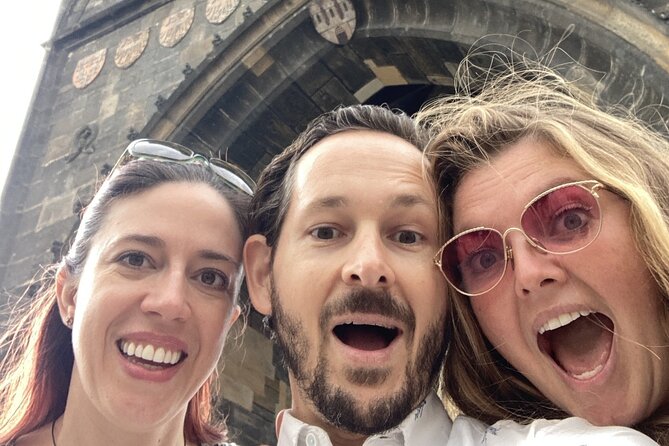
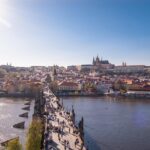
Then you’ll get Old Town Bridge Tower, a Gothic structure that once worked like a triumphal arch for the Kings of Bohemia. During coronations, kings crossed it as part of the Royal Way, which started in the Old Town and led up to St. Vitus Cathedral at Prague Castle.
That’s the key idea here: the bridge wasn’t just crossing water. It was part of the official political choreography. The tower also had a defensive purpose, built into the city’s defense system to protect the Old Town from northern invaders. Construction and decoration involved around one hundred stonemasons, which gives you a sense of the effort behind what can feel like a simple photo spot.
St. Nicholas Church and the 215-step view: Prague rewards you for climbing
Next comes St. Nicholas Church. It was founded by the Jesuits and is described as one of the largest churches in Prague. Today it belongs to the Czechoslovak Hussite Church.
If you want literary Prague, there’s a strong connection nearby. A house next to the church is noted as the birthplace of writer Franz Kafka.
For views, the church includes a climb of 215 steps. From up there, you’ll see over the Lesser Town and across the Vltava River to the Old Town. The info also notes that at night, Old Town Square is lit by lanterns, which can make for an unforgettable view.
Interior visiting is daily except Sundays, when Holy Mass is usually held. Even if you can’t go in right at your time, the outside setting plus the step climb can still make this one of the most rewarding stops in the route.
Prague Castle: the final push, Wrestling Titans, and changing guards
Your last big location is Prague Castle. This is where the route earns its “wow” factor.
At the Matthias Gate, you’ll see the Wrestling Titans (also called Fighting Giants), a pair of outdoor sculptures. The castle itself was the seat of the Kings of Bohemia, and kings were buried here. Today, it’s also where the president of the Czech Republic has offices.
There’s a practical detail that’s great if you like watching routine in real places: every hour you can watch the changing of the presidential guards at the three main entrances to the castle.
For puzzle-walk logic, this ending works well. You finish at a place that already has a natural “arrival energy,” so even if you’ve solved clues for two hours, you’ll still feel like you landed somewhere important.
Old Town Hall and the Astronomical Clock’s legend
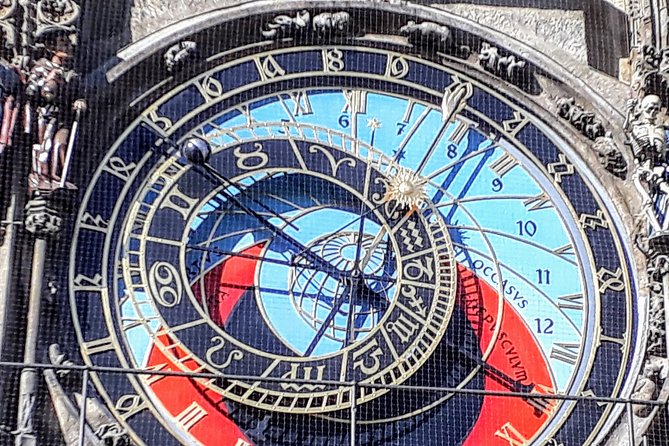
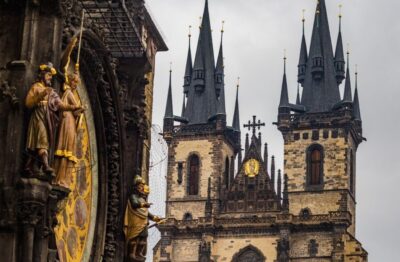
Before you fully wrap up, the route includes Old Town Hall with the Astronomical Clock (Orloj). The Orloj is described as the third-oldest astronomical clock in the world and one of Prague’s iconic gems since the early 15th century.
The clock is fascinating because it shows more than time: it displays astronomical information like the position of the Sun and Moon, plus zodiacal information. It was damaged during World War II when the Czechs fought occupying Nazi forces, and it was repaired afterward, starting again in 1948.
There’s also a legend tied to the idea that if the clock were broken beyond repair, the city would suffer. Whether you treat that as folklore or not, it adds a layer of drama to simply standing there and watching the moving parts.
One note for your budget: this stop has admission not included for about 10 minutes, so check on the spot what you’re paying for if you want full access around the clock area.
Lesser Town Bridge Tower: ravens, a missing stone, and a knight’s fate
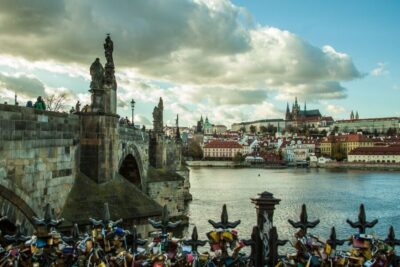
Finally, you’ll reach The Lesser Town Bridge Tower on the Malá Strana side at the end of Charles Bridge. Unlike the Old Town Bridge Tower, these towers were never decorated, and they include Romanesque reliefs inside.
They also relate to defense: the smaller tower is described as part of fortification systems in the days of the Judith Bridge.
Then there’s the legend that makes this stop feel like a chapter ending. The story says there’s an empty spot where a stone is missing. Chroniclers claim ravens sat on the stone and made it fall onto the head of King Václav’s favorite knight. The knight is said to have fought many battles, but this one stone dislodged by birds instantly killed him. The king never replaced the stone to honor his legacy.
Again, the value of the puzzle walk is that you’re not just learning a legend at random. You’re actively solving your way through it.
Is the $7.21 puzzle walk worth booking?
At $7.21 per person, this is priced like a budget-friendly way to see a lot without joining a typical group tour. The value improves if you fit the style of the experience: you like moving at your pace, you’re okay reading and solving instead of listening to a guide for every stop, and you want your route to cover a concentrated slice of Prague.
The best parts are consistent with what people usually praise for this kind of setup:
- A strong “see a ton” route: churches, bridges, and castle sights tied together logically.
- Freedom to pause: the game structure makes it easy to stop for a drink or shopping without breaking anything.
- Real payoff in views: especially the step climb at St. Nicholas and the big finishing energy at Prague Castle.
One watch-out from the experience style: if you expect the story to be a major, immersive narrative, you might find it lighter than you hoped. Some people also naturally rush when they’re chasing the next clue, which can shorten how long you spend appreciating interiors and details.
I’d book this if:
- it’s your first or second time in Prague and you want a fast hits-and-icons route,
- you want to avoid guide crowds and human logistics,
- you enjoy self-directed exploration and puzzles.
I’d skip it (or at least adjust expectations) if:
- you hate puzzles or need a spoken guide to get context,
- you want more historical interpretation delivered by a person, not by short explanations,
- you have mobility limits due to walking and notable stairs like the 215-step climb.
If you’re the type who can wander for two hours and still feel curious, this one is a smart, low-cost way to do it.
FAQ
FAQ
How long is this Prague puzzle walk?
It’s listed at about 2 hours.
Where does the route start and end?
It starts at Wenceslas Square and ends at Prague Castle.
Is it really self-guided, or do I meet a tour guide?
It’s self-guided and there is no physical tour guide included.
Do I need an internet connection?
No. The game is designed to be played offline, so you do not need internet to play.
What language is it offered in?
It’s offered in English.
Are entrance tickets included for the sights?
Most stops note admission ticket free. The Old Town Hall with Astronomical Clock has admission not included for about 10 minutes.
Can I start at any time?
Yes. It’s available to book 24/7 every day, and you can start at any hour.
What if I need to cancel?
You can cancel for free up to 24 hours in advance for a full refund. If you cancel less than 24 hours before the start time, the amount paid is not refunded.
More Prague Walking Tours

More Tour Reviews in Prague



The Old Town, A Few More Ways
More Prague tours we have written up lately


Old Town & Astronomical Clock, compared.
 ★ 4.3Oldtown, Medieval Underground & Dungeon History TourFrom $3110,277 reviews
 ★ 4.5Old Town Hall Tower Entry TicketFrom $216,749 reviews
 ★ 4.73-Hour Walking Tour of Old Town & Prague CastleFrom $305,696 reviews
 ★ 4.83-Hour Old Town and Prague Castle Tour in GermanFrom $365,671 reviews
 ★ 4.5Prague Old Town, Medieval Underground and Dungeon Historical TourFrom $323,227 reviews
 ★ 4.8Old Town and Jewish Quarter Guided Tour in GermanFrom $293,143 reviews
 ★ 4.5Ghosts and Legends of the Old Town Evening TourFrom $213,091 reviews
 ★ 4.6Old Town and Jewish Quarter Guided Walking TourFrom $222,847 reviews
Browse the lists this tour appears in