
REVIEW · PRAGUE WALKING TOURS
Private Prague Art Nouveau and Cubism Walking Tour
Prague has two art movements that clash beautifully. This private walking tour is a fast, fun way to spot Art Nouveau elegance and Cubist boldness across Prague without needing an art degree. I especially love how the guide turns buildings into clues you can read on your own, and I like the route choice that mixes major landmarks with street-level details. One thing to consider: the pace is hands-on, with walking and some transit, and it can run a bit past the posted 2.5 hours.
I also like that this tour feels like orientation, not just sightseeing. You’ll start near Prague’s big train hub, then work your way toward Wenceslas Square and finish at Albertov, where it’s easy to hop back into the city flow. Your group stays small (up to 15), and you’re working with one guide from start to finish.
If you’re short on time but want to understand why Prague looks the way it does, this is a smart pick. Just know you’ll see many exteriors close-up, and a few indoor stops list tickets as not included.
In This Review
- Key things that make this tour worth your time
- A private Art Nouveau and Cubism route that actually trains your eye
- Starting at Prague Main Station: the Art Nouveau welcome mat
- Jerusalem Synagogue: when Moorish flavor meets Art Nouveau timing
- Senovážné náměstí apartments: Art Nouveau turned into everyday living
- Hotel Central Palác (Hybernská 10): early Art Nouveau with a sharp identity
- Obecní dům (Municipal House): the big Art Nouveau anchor
- The House at the Black Madonna: Prague Cubism’s flagship energy
- From Na Příkopě to Wenceslas Square: Art Nouveau continues as a city habit
- Vodičkova and the Cubist lamppost: street details that feel like architecture homework
- Three Cubist Houses and Villa Kovařík: Cubism expands from facades to form
- Neklanova street: closing with one last Cubist cue
- Timing, walking, and why the 2.5 hours feels like a full lesson
- How the tour ends at Albertov and what to do next
- Value check: is $94.93 per group a good deal?
- Who this tour fits best (and who should reconsider)
- Should you book this Prague Art Nouveau and Cubism tour?
- FAQ
- How long is the Private Prague Art Nouveau and Cubism Walking Tour?
- Is this tour private or shared?
- What language is the tour offered in?
- Where does the tour start?
- Where does the tour end, and can I use public transport afterward?
- Are admission tickets included for all stops?
- Do I get a mobile ticket?
- Are service animals allowed?
- Can I cancel for a full refund?
Key things that make this tour worth your time
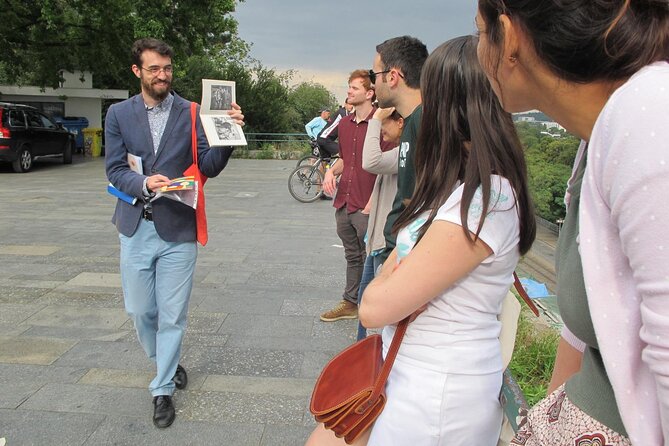
- Max Hutar guides you with story-driven architectural context, so styles make sense fast
- A route built to train your eye: facades first, then signature Cubist “why is that building shaped like that?” moments
- Mix of big-name sites and small street details, including a famous Cubist lamppost
- Private group format (up to 15) keeps the pace realistic and the questions focused
- A finish at Albertov that pairs well with public transport so you don’t feel stranded
Prefer to cover it on foot? More Prague walks across the old lanes.
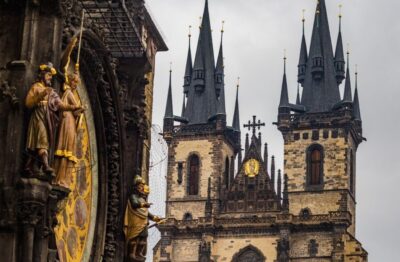
- Prague: 3-Hour Walking Tour of Old Town & Prague Castle★ 4.7 · 5,696 reviews
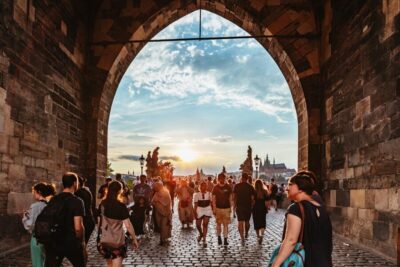
- Prague: Ghost Walking Tour Where Legends Come To Life★ 4.4 · 5,253 reviews
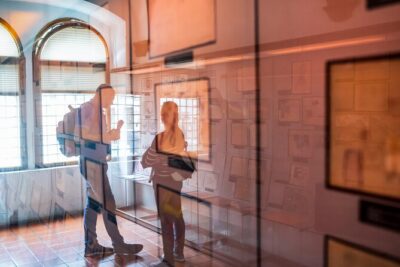
- Prague: Jewish Quarter Walking Tour with Admission Tickets★ 4.7 · 3,729 reviews
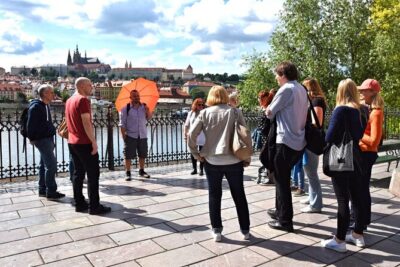
- Prague Guided Walking Tour and Cruise with Authentic Czech Lunch★ 5.0 · 3,627 reviews
A private Art Nouveau and Cubism route that actually trains your eye
Prague can feel like one long postcard until you start looking closely. This tour is designed to do the opposite. Instead of dumping dates in your lap, it teaches you what to notice: curved ornament, stylized forms, sharp geometric angles, and the way buildings communicate mood.
What makes it click is the balance of movements. Art Nouveau tends to charm you with flowing lines and decorative surfaces, while Cubism pushes back with fractured forms and bold, almost defiant geometry. By the end, you’re not just recognizing names—you’re starting to read the city like a visual language.
Also, the private setup matters. With a group sized up to 15, you can actually stop, look, and ask without feeling like you’re trapped in a moving crowd. And because it’s offered in English with a mobile ticket, you can show up prepared without hunting for printed documents.
Starting at Prague Main Station: the Art Nouveau welcome mat
You kick off at Prague hlavní nadrazi (Prague Main Station). The stop centers on the station’s grand, early-1900s character—opened in 1909 and recently reconstructed. Even if you don’t plan to ride the rails, it’s a strong place to begin because it immediately signals the theme: Prague didn’t just decorate—it experimented.
This is a practical warm-up too. You’re in a major landmark area with easy transit access, so your bearings start getting set right away. If you’re the type who likes to understand cities by their “systems,” it helps that you begin at the transportation heart of the city.
The station stop also lists admission as free, which is a nice bonus for value. You can spend time in the halls and corridors without worrying about a ticket requirement.
Jerusalem Synagogue: when Moorish flavor meets Art Nouveau timing
Next comes the Jerusalem Synagogue, built in a traditional Moorish style but from a period (1906) when Art Nouveau was popular. This is a fascinating contrast because it reminds you that Prague’s architecture doesn’t follow one strict rule book.
Here’s the key takeaway: Prague’s designers borrowed. They adapted. They blended influences and adjusted them to local taste and materials. Even if you only get a short look during this stop, it gives you a mental hook for the rest of the day—styles aren’t isolated bubbles.
Admission is not included for this stop, so don’t plan this one as a “guaranteed interior visit” moment. You can still learn a lot from the exterior and the overall idea, but if interior access is important to you, you may need to plan around separate ticketing.
Senovážné náměstí apartments: Art Nouveau turned into everyday living
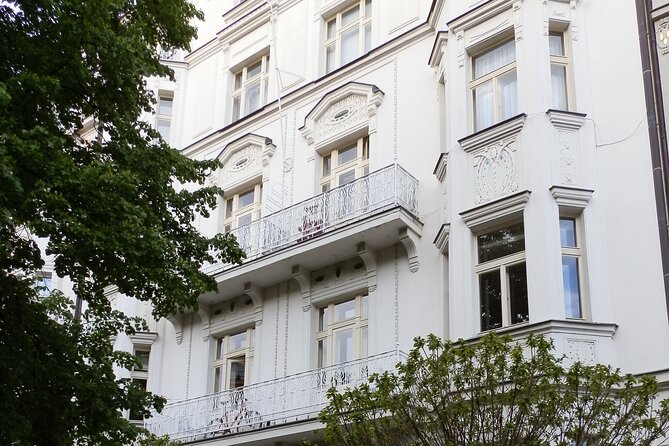
Then you head to Senovážné náměstí, one of New Town’s squares. The focus here is on three luxurious apartment buildings from the Art Nouveau era, where you can see the style in a residential setting.
This is one of those stops I really like for learning. It’s one thing to appreciate ornament on a major public building. It’s another to see it where people actually lived—where design had to be both beautiful and livable.
The stop is short, and admission is free, so it’s best treated as a quick pattern-finder. Train your eye for repeating details: window shapes, balconies, surface texture, and how the “decor” looks integrated rather than pasted on.
Keep walking. More of Prague at street level.


Hotel Central Palác (Hybernská 10): early Art Nouveau with a sharp identity
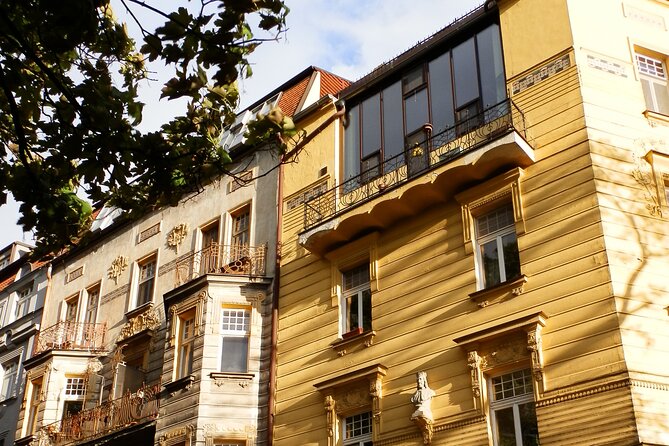
At Hybernská 10, the tour points to the Hotel Central Palác from 1899, described as one of Prague’s earliest Art Nouveau buildings. Even without a long stop, this kind of early example helps you understand evolution. When you later see more famous works, you’ll be able to spot what became more refined and what stayed consistent.
The drawback here is simple: admission is not included at this stop. So expect more of an exterior-focused viewing experience than a full inside-and-out look.
Still, for architecture lovers, early buildings are often more rewarding. They show the moment designers were figuring things out.
Obecní dům (Municipal House): the big Art Nouveau anchor
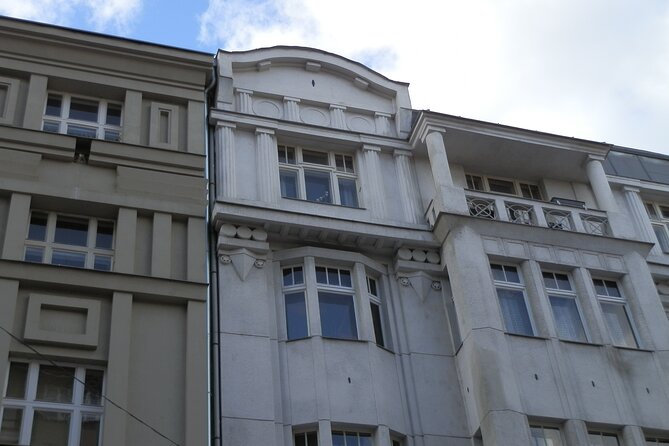
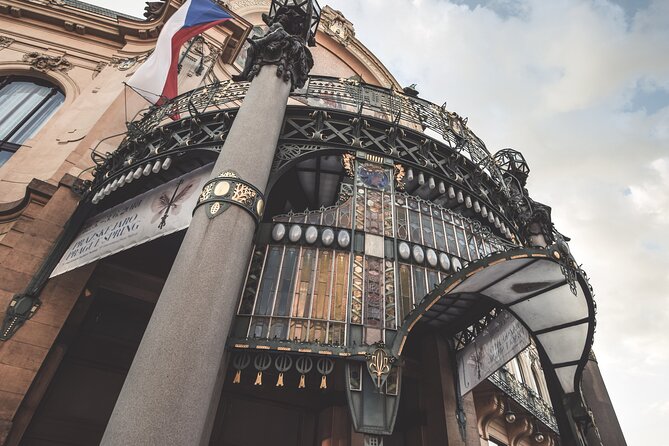
Obecní dům is projected in 1905 and is still used as a cultural hub. It’s positioned as one of Prague’s biggest and most important Art Nouveau pieces—so naturally, it works as a centerpiece.
This is where you’ll start to see how Art Nouveau can be both decorative and civic. The Municipal House isn’t just a pretty face; it communicates pride, ambition, and a belief that public architecture should feel like culture—not just function.
Admission is not included during this stop, so again, plan around exterior viewing unless you choose to handle entry separately.
Even if you don’t go inside, it’s worth it. You’re learning proportions, façade rhythm, and how ornament interacts with structure.
The House at the Black Madonna: Prague Cubism’s flagship energy
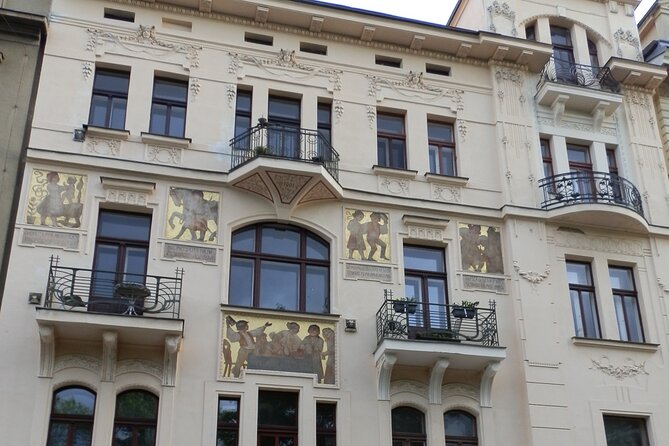
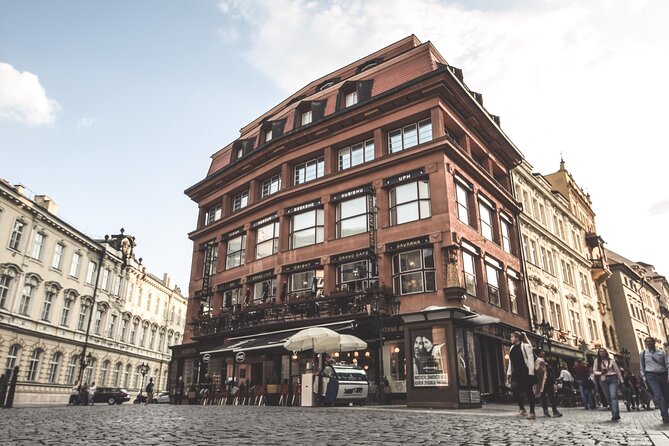
Then the tour shifts decisively into Cubism with the House at the Black Madonna (1912). It’s framed as a flagship example of Cubist architecture pioneered in Prague just before World War I.
This stop is the “wait, what?” moment for many people. Cubism doesn’t just decorate a building; it rearranges how the building reads. The shapes can feel like they’re breaking the rules of normal walls and massing, as if the façade is a set of angled planes frozen mid-change.
Expect a short visit and mostly outside views, since admission is not included here. But don’t underestimate how much you can learn from stepping back and looking for lines that don’t behave normally. The guide’s storytelling style helps you connect these shapes to the broader Cubist idea.
From Na Příkopě to Wenceslas Square: Art Nouveau continues as a city habit
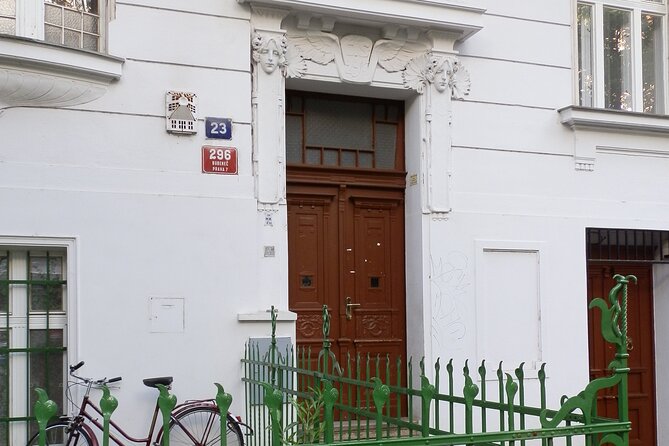
Na Příkopě is described as a borderline boulevard between Old Town and New Town, lined with banks and other buildings in the Art Nouveau style. This is a smart segment because it keeps you in motion while still feeding the theme.
The stop is brief, and it’s free to view, so you can use it like a refresher. Look at façades as you walk: do you see curves, floral-like motifs, or stylized forms? Then check how those details change when you approach a new block.
Next up is Vaclavské náměstí (Wenceslas Square). The tour gives it time—around 20 minutes—and highlights Art Nouveau hotels and department stores. This helps you understand how commercial Prague used design, not just government buildings and churches.
The free admission note suggests this is another “look closely from the outside” stop. Use it that way: treat Wenceslas Square like a gallery wall at street level.
Vodičkova and the Cubist lamppost: street details that feel like architecture homework
Vodičkova is another free, short stop with multiple Art Nouveau and Cubist buildings. The value here is variety within a small walking radius. You’ll start noticing that Cubism can appear in unexpected places, not only in famous façades.
One of the most unique moments is Emil Kralicek’s Cubist lamppost. A street furniture piece might sound small, but this is exactly the point. Cubism wasn’t only for grand architecture. It showed up in public space, as if the entire city environment could share the same design mindset.
This stop is marked free and lasts about 5 minutes, but it sticks in your head. It’s the kind of object that makes you look at other street corners with new suspicion—in a good way.
Three Cubist Houses and Villa Kovařík: Cubism expands from facades to form
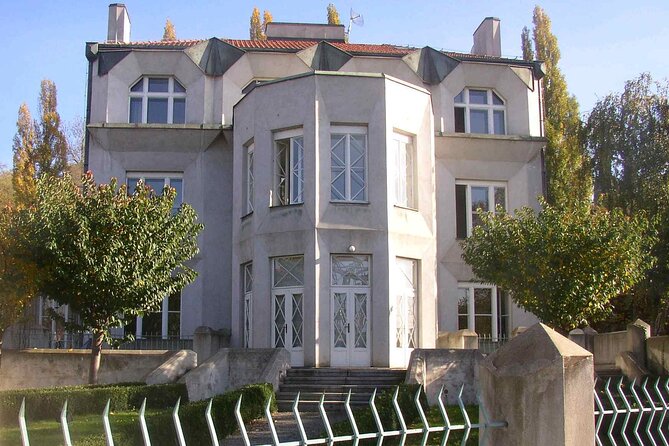
The triplet of houses known as Three Cubist Houses is described as a famous construction under the rock of the Vyšehrad fortress. This stop is ticket not included, so plan for what you can see without assuming an interior visit.
Still, Cubist massing is easiest to understand when you can view it as a whole group. A triplet also gives you pattern recognition: similar design logic, slightly different execution.
Then you get Villa Kovařík near the Vltava river banks, built in 1912 and inspired by Gothic and Baroque alongside Cubist ideas. This is the part where Prague’s Cubism starts to feel less like a single style and more like a design attitude. It can mix influences, then snap them into geometric solutions.
Again, admission is not included, so take it as an exterior learning stop unless you separately plan entry.
Neklanova street: closing with one last Cubist cue
The final stop on Neklanova wraps the tour with an amazing Cubist apartment building from 1913. It’s a short stop (about 5 minutes), but a good way to end because apartment buildings bring the story back to daily life.
By the time you reach this point, you’ll probably recognize Cubist cues faster: unusual angles, fractured planes, and the sense that the façade is engineered rather than merely decorated.
It’s also a nice mental finish line. After this, your brain keeps running the pattern in other neighborhoods.
Timing, walking, and why the 2.5 hours feels like a full lesson
The tour duration is about 2 hours 30 minutes, but the on-site time listed for stops doesn’t add up perfectly. That’s because you’ll spend time walking between points and taking public transportation at one point.
So, treat it as a half-day block of energy, not a tight 150-minute sprint with no delays. One review also flags that walking is involved and it can go longer than the advertised time, which matches how city architecture tours usually play out when you stop to look closely.
If you hate walking, choose your footwear carefully and plan to move at a steady pace. If you’re curious and enjoy lingering, this route rewards that instinct.
How the tour ends at Albertov and what to do next
You finish at the Albertov tram stop, where the same public transportation ticket used for the last leg of the tour is still valid long enough to get you back into the heart of the city center. This is practical and underrated: you’re not stuck figuring out transit while your brain is full of new architectural impressions.
The tour’s end point is also listed as Na Slupi 2102/2b (on Nové Město). Either way, the key is that Albertov is a convenient “bridge” back toward central Prague.
Afterward, I’d suggest using your newfound eye on nearby streets. You’ll start seeing how Art Nouveau and Cubism show up in the ordinary, not just the famous.
Value check: is $94.93 per group a good deal?
The price is $94.93 per group (up to 15). That sounds like it’s for a group, not per person, so the value depends on how many people you travel with.
If you’re a duo, you still get a strong deal because it’s private and focused—one guide, one theme, one route. If you’re a small family or a group of friends, the per-person value becomes even easier to justify. You’re paying for time, expert interpretation (by Max Hutar), and a curated route that hits both Art Nouveau and Cubism without wasting hours on guesswork.
One possible value snag: several stops list admission tickets as not included. That means you might pay separately if you want interiors. But even when tickets aren’t included, you still get a lot of architectural payoff from outside viewing and guided explanation.
Who this tour fits best (and who should reconsider)
This tour is a great match if you love design, enjoy reading buildings like text, and want a Prague introduction that goes beyond Charles Bridge and old-town cobblestones. It also suits people who want structure: you get a planned route and a clear architectural theme, not a vague wander.
It’s less ideal if:
- you want mostly indoor museum time
- you dislike walking or standing for façade viewing
- you expect all stops to include ticketed access
If you’re unsure, the best way to decide is your goal. Want inspiration and recognition? Book. Want a ticketed checklist of interiors? Look closely at which stops are ticket-not-included.
Should you book this Prague Art Nouveau and Cubism tour?
I’d book it if you want a memorable, educational way to see Prague’s architecture up close, and you like the idea of leaving with a trained eye. The highlight for me is the route logic: you start with a major Art Nouveau anchor, then sharpen your perception until Cubism feels obvious rather than confusing.
Also, it’s been booked on average 25 days in advance, so if your dates are fixed, don’t wait until the last week to grab your spot.
If you’re traveling with a small group and you can handle some walking, this is a strong value at $94.93 per group and it gives you a lens you’ll use for the rest of your stay.
FAQ
How long is the Private Prague Art Nouveau and Cubism Walking Tour?
It runs about 2 hours 30 minutes.
Is this tour private or shared?
This is a private tour/activity. Only your group participates.
What language is the tour offered in?
The tour is offered in English.
Where does the tour start?
You start at Prague Main Station, Wilsonova 300/8, Vinohrady, 120 00 Praha-Praha 2, Czechia.
Where does the tour end, and can I use public transport afterward?
The tour concludes at the Albertov tram stop. The same public transportation ticket used for the last leg is valid long enough to help you get back toward the city center.
Are admission tickets included for all stops?
No. Some stops are marked with free admission, while several others list admission as not included, such as the Jerusalem Synagogue, Hotel Central Palác, Obecní dům, House at the Black Madonna, Three Cubist Houses, and Villa Kovařík.
Do I get a mobile ticket?
Yes, it uses a mobile ticket.
Are service animals allowed?
Yes, service animals are allowed.
Can I cancel for a full refund?
Yes. Free cancellation is available, and you can cancel up to 24 hours in advance for a full refund.
More Tours in Prague

More Tour Reviews in Prague


On Foot Through Prague, Continued

More Prague tours we have written up lately


Prague Walking Tours, compared.
 ★ 4.73-Hour Walking Tour of Old Town & Prague CastleFrom $305,696 reviews
 ★ 4.4Ghost Walking Tour Where Legends Come To LifeFrom $275,253 reviews
 ★ 4.7Jewish Quarter Walking Tour with Admission TicketsFrom $763,729 reviews
 ★ 5.0Prague Guided Walking Tour and Cruise with Authentic Czech LunchFrom $1023,627 reviews
 ★ 4.6Old Town and Jewish Quarter Guided Walking TourFrom $222,847 reviews
 ★ 4.5Prague Ghost and Legend of Old Town Walking TourFrom $212,630 reviews
 ★ 5.0Prague 3-hour Afternoon Walking Tour including Prague CastleFrom $531,899 reviews
 ★ 4.7Ghosts and Legends Nighttime Guided Walking TourFrom $221,462 reviews
Browse the lists this tour appears in