
REVIEW · PRAGUE WALKING TOURS
Prague Art Nouveau and Cubism Walking Tour
Prague’s architecture has a secret education. This walking tour lets you read Art Nouveau and Cubism in real time, spotting details like gingko leaves on façades and the crystal-like sharpness of Cubist design. I like the way the guide turns buildings into clues, from Eastern art influences to the bold, curvy lettering style of the era.
One thing to consider: it’s still a walking tour with multiple stop-and-look moments, so plan for max 8 people moving at a group pace and bring comfy shoes. Even on a rainy day, the route is designed to keep things moving, but your feet will feel the weather.
In This Review
- Key highlights you’ll care about before you book
- Prague Art Nouveau and Cubism: why this tour works
- Meeting point to walking rhythm: how the tour starts
- Stop 1: House of the Black Madonna and Prague’s Cubist edge
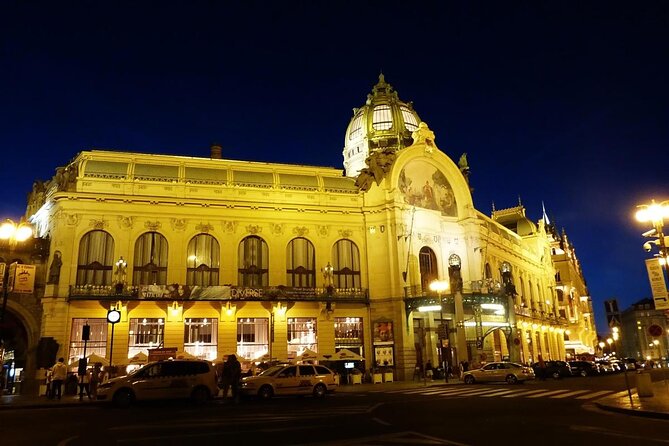
- Stop 2: Obecní dům and Art Nouveau you can recognize fast
- Stop 3: K+K Hotel Central Prague, the Art Nouveau starting gun
- Stop 4: Café Imperial and what interior design can teach
- Stop 5: Czechoslovak Legion Bank and World War I symbolism
- Stop 6: Prague Main Train Station’s Art Nouveau dome
- Stop 7: Wenceslas Square, where Art Nouveau meets Art Deco ideas
- Stop 8: Lucerna Music Bar and Prague’s optimistic design mood
- Stop 9: The upside-down statue and Czech National Revival symbolism
- The tour finish at Café Louvre: where to eat and what to remember
- Practical value: price, group size, and what you truly get
- Who this tour is best for (and who should skip it)
- Should you book Prague Art Nouveau and Cubism?
- FAQ
- How long is the Prague Art Nouveau and Cubism walking tour?
- What is the starting point and where does the tour end?
- Do I need to buy tickets for the stops?
- Is the tour offered in English?
- How large is the group?
- Is there a choice of departure time?
- Is hotel pickup or drop-off included?
- What should I do about food and drinks?
- What’s included in the price?
- Is confirmation provided after booking?
Key highlights you’ll care about before you book
- Small group size (up to 8) helps you ask questions and get route tweaks.
- Art Nouveau + Cubism contrast shows up block by block, not just in theory.
- Historian guide storytelling connects design with history, wars, and daily life.
- Free-entry stops listed on the route let you focus on the interiors and details without extra ticket hassle.
- Ends near major sights at Café Louvre, opened in 1902, with a classic café atmosphere.
Prefer to cover it on foot? More Prague walks across the old lanes.
- Prague: 3-Hour Walking Tour of Old Town & Prague Castle★ 4.7 · 5,696 reviews
- Prague: Ghost Walking Tour Where Legends Come To Life★ 4.4 · 5,253 reviews
- Prague: Jewish Quarter Walking Tour with Admission Tickets★ 4.7 · 3,729 reviews
- Prague Guided Walking Tour and Cruise with Authentic Czech Lunch★ 5.0 · 3,627 reviews
Prague Art Nouveau and Cubism: why this tour works
Prague isn’t just one style city. It’s a layered one. On this 3-hour walk, you see how Art Nouveau and Cubism grew out of the same turning point in Europe—when people wanted modern design but also argued about what counted as culture.
The value here is the pairing. Art Nouveau teaches you to look for nature motifs and ornamental flourishes—like the gingko leaves the guide helps you notice—while Cubism asks you to see geometry first. You get help spotting that shift in the real streets, so the styles stop being museum labels and start feeling like a language you can read.
And the tour doesn’t treat design as decoration only. It brings in practical construction tech and social context, including central heating and ventilation, drinking water systems, hydraulic elevators, steam-powered laundry, and even an intercom system. That kind of detail makes the architecture feel grounded in everyday life, not just “pretty buildings.”
Meeting point to walking rhythm: how the tour starts
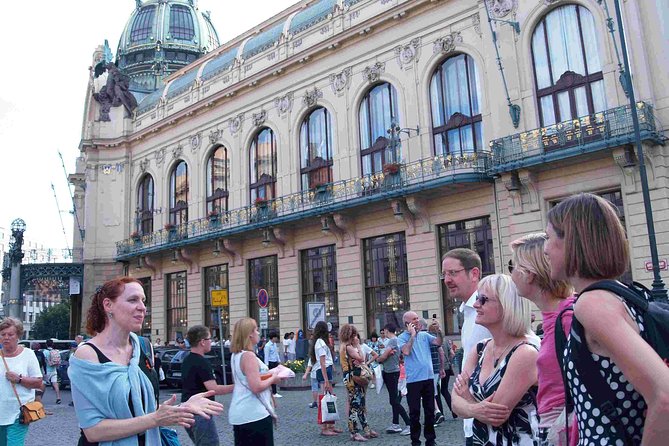
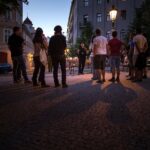
You meet at Ovocný trh 19 in Staré Město (Old Town), near public transportation. The walk is timed to keep you looking at a manageable pace, with quick stop durations (often around 5 to 15 minutes each), so you’re not stuck at one corner for an hour.
If you’re worried about timing, this is one of the calmer ways to do architecture in Prague. The max group size (up to 8) means the guide can slow down for questions and speed up when your group is ready. English is offered, and you can choose a morning or afternoon departure.
Guides you may get include historians such as Vadim, Betty, Matous, Bonita, or Vitam, and the common theme is clear: they lean into questions and tailor what you focus on. In practice, that often means you spend more time where you’re most interested—say, Cubism if that’s your thing.
Stop 1: House of the Black Madonna and Prague’s Cubist edge
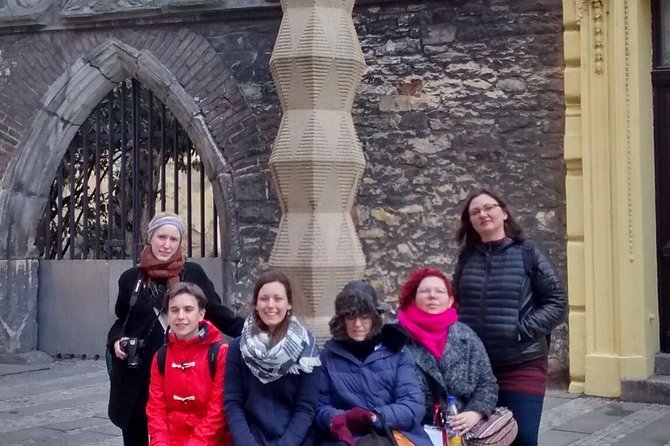
The tour begins with the House of the Black Madonna, a building in Cubist style. This is your first “set the mindset” moment: instead of leaf curls and swirls, you’re looking for angles, fractured forms, and those dramatic, almost faceted shapes.
What I like about starting here is that it forces your eyes to adjust early. Once you’ve trained yourself to spot Cubism’s geometry, the later transitions to Art Nouveau feel sharper, not confusing.
This stop is listed at about 10 minutes and has free admission. That’s helpful if you’re trying to keep the day efficient without hunting for tickets or extra fees.
Stop 2: Obecní dům and Art Nouveau you can recognize fast
Next up is Obecní dům (Municipal House), one of Prague’s iconic Art Nouveau landmarks. If you’ve ever seen photos of this building, you know the look—but the guide helps you see the building as a whole system of design choices.
Art Nouveau here isn’t just “ornament.” It’s a street-level lesson in form. You’ll learn what to watch for on façades and how design elements connect to the broader movement, including Eastern artistic influence. You’ll also hear how the era treated craftsmanship and technology as partners, not enemies.
Time on this stop is around 15 minutes, with free admission listed. With that length, you can usually get a clear exterior read, plus enough context to understand what you’re seeing.
Keep walking. More of Prague at street level.
Stop 3: K+K Hotel Central Prague, the Art Nouveau starting gun
Then you’ll walk by or focus on the K+K Hotel Central, described as the first Art Nouveau building in Prague. That detail matters. When a building is “first,” it becomes a reference point. Later Art Nouveau work in the city starts to make more sense because you’re seeing the origin.
This stop is short (about 10 minutes), but it’s a good one if you like “why it mattered” explanations. You can quickly connect motifs and design logic to how the movement grew in Prague after it landed.
Free admission is listed, so you’re not paying extra just to get the context.
Stop 4: Café Imperial and what interior design can teach
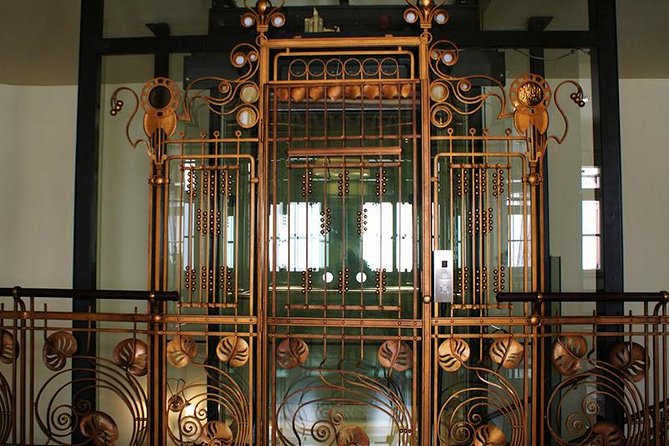
The tour’s momentum continues with Café Imperial, where the focus is on the interior. If you usually only glance at famous façades, this is a smart reminder that the design didn’t stop outside. Interiors reflect the optimism and confidence of the turn-of-the-century Czech public—at least before wars and political shocks changed daily life.
This stop is only about 5 minutes, so don’t expect a long sit-down. Treat it like a quick visual checklist: materials, curves, lighting, and the overall mood of the period.
Free admission is listed here too. Since food and drinks aren’t included unless specified, you can save your spending for later, when the tour ends.
Stop 5: Czechoslovak Legion Bank and World War I symbolism
Next is the Czechoslovak Legion Bank, a Cubist architecture stop with an interior dedicated to the Czechoslovak Legion of the First World War. This is where the tour shifts from pure style spotting into how architecture carries memory.
It also helps explain why Prague’s design story isn’t just aesthetic. The era’s wars and political upheaval changed what could be built, how people thought about the future, and what they felt proud of. Buildings became a kind of public messaging.
Time here is about 10 minutes, with free admission listed. Even if you aren’t a history buff, the Legion theme gives the Cubist look a clear reason to exist beyond appearances.
Stop 6: Prague Main Train Station’s Art Nouveau dome
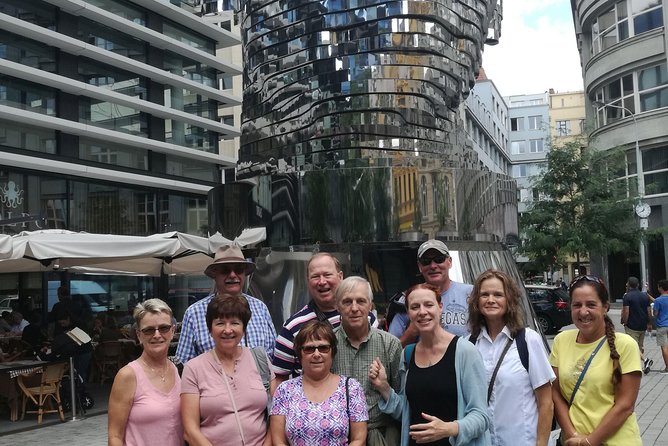
The tour heads to Praha hlavní nadrazi (Prague Main Train Station) for a famous Art Nouveau dome interior moment. Stations are usually where you hurry through. Here, you slow down and look up.
The dome is a highlight because it makes the “Art Nouveau as engineering ambition” idea tangible. Add in the earlier tour discussion of construction systems—central heating and ventilation, drinking water, hydraulic elevators, steam-powered laundry, and intercom—and the station feels less like a transit building and more like a showcase of modern life.
This stop is about 10 minutes and free admission is listed. The practical benefit for you: if you’re arriving or departing by train, this tour helps you navigate the building with confidence.
Stop 7: Wenceslas Square, where Art Nouveau meets Art Deco ideas
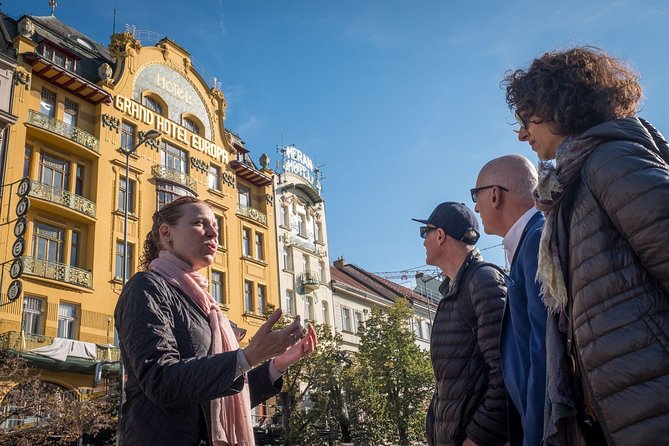
Then you’ll spend around 15 minutes at Wenceslas Square, focusing on Art Nouveau and Art Deco architecture. This is a useful stop because it shows design doesn’t neatly switch styles overnight. The square becomes a “timeline on the ground.”
The guide also ties the square’s buildings to Czech cultural change, including how people wanted to express identity through design. If you’re the type who takes photos, this is a good place to slow down and line up your shots, because the architecture is spread out enough to compare.
Free admission is listed for this segment. That keeps the focus on observation instead of ticket logistics.
Stop 8: Lucerna Music Bar and Prague’s optimistic design mood
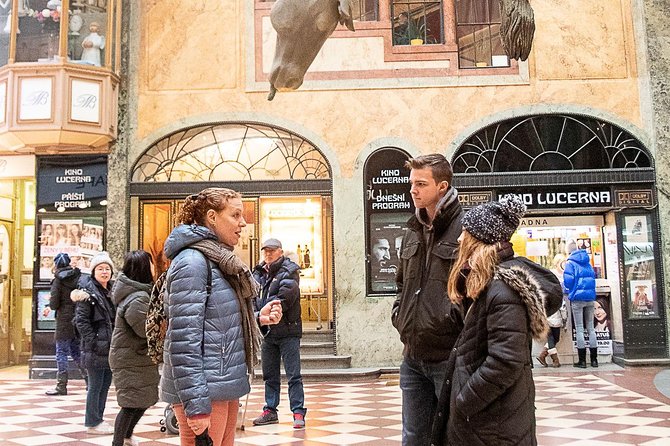
The tour reaches Lucerna Music Bar (often associated with the arcades and turn-of-the-century vibe). You’ll look at the Art Nouveau interior of what are described as some of Prague’s most beautiful arcades.
This stop is about 10 minutes and free admission is listed. Even if you don’t plan to spend a long evening there, it’s worth seeing once because the interior gives context to why people loved the era’s design language—curves, light, and a sense that the future looked promising.
It’s also a strong contrast to the war story portions of the tour. You see both the hope and the later consequences, without the day turning gloomy.
Stop 9: The upside-down statue and Czech National Revival symbolism
The final architecture-to-history connection is the Upside-Down Statue of King Wenceslas riding a dead horse. This stop is about 10 minutes and it’s framed as symbolism in the context of Czech history and the Czech National Revival.
This is where the tour earns its street-level street smarts. The statue isn’t Art Nouveau or Cubism, but it helps you understand how Prague keeps reinterpreting its past through public art. That’s part of the city’s design culture too.
The free admission listing applies to this segment as well. The real “payoff” is your new way of reading symbolism, not a ticketed interior.
The tour finish at Café Louvre: where to eat and what to remember
You finish near the action at Café Louvre on Národní 22. Café Louvre opened in 1902, and the tour notes the café atmosphere was known to people such as Franz Kafka, Albert Einstein, and T. G. Masaryk.
Even though food isn’t included, this ending point is a practical win. You can grab a meal or a drink right after the walk and keep the architecture lessons going while the details are still fresh.
Since the route ends close to restaurants and major attractions, you’re not forced into a long walk back to wherever you’re staying.
Practical value: price, group size, and what you truly get
The price is $126.71 per person, for about 3 hours, with a historian guide and a small group size (max 8). On paper, it can feel like a lot—especially if you’ve only budgeted for classic “see the sights” tours.
Here’s the value argument that makes sense. This tour isn’t only showing buildings; it’s teaching you how to spot features: gingko leaves on Art Nouveau façades, curvy typography influences, Eastern aesthetic roots, Cubism’s crystal-like forms and pyramid shapes, and the way architecture linked to modern systems like heating, elevators, and water access.
If you’re the type who likes to understand what you’re looking at, that translation from style to meaning makes the ticket cost easier to justify. If you only want photos with minimal explanation, it may feel pricier than you expect.
One more practical note: the tour is often booked about 69 days in advance, so if you travel in peak seasons or on popular departure times, plan to reserve early.
Who this tour is best for (and who should skip it)
This is a strong pick if you:
- want a structured way to see Art Nouveau + Cubism in the same day
- like architecture with history and context
- enjoy asking questions and getting answers in an English-speaking group of up to 8
- want a route that helps you get your bearings, including guidance at the main train station
It may be less ideal if you:
- want a purely relaxed sightseeing stroll with no stop-by-stop focus
- dislike walking tours with multiple quick exterior and interior moments
- aren’t interested in design details and prefer something more about neighborhoods or food
The best part is that the small-group setup gives you a chance to steer the focus, something guide experiences like Vadim’s, Betty’s, Matous’s, Bonita’s, and Vitam’s commonly highlighted.
Should you book Prague Art Nouveau and Cubism?
Yes, if your goal is to see Prague in a way that makes the city “stick.” This tour is built for pattern recognition: you walk away with a mental checklist for Art Nouveau and Cubism, plus the historical reasons those styles took hold in Prague.
It’s also a good start-of-trip activity, because it makes later architecture experiences easier to read. If you’re already excited by façades, domes, arcades, and public symbolism, this is one of the more rewarding ways to spend three hours in the center of town.
FAQ
How long is the Prague Art Nouveau and Cubism walking tour?
It lasts about 3 hours.
What is the starting point and where does the tour end?
You start at Ovocný trh 19 in Staré Město (110 00 Praha-Praha 1) and end at Café Louvre, Národní 22, 110 00 Praha 1.
Do I need to buy tickets for the stops?
Admission is listed as free for the stops on the itinerary. Food and drinks are not included unless specified.
Is the tour offered in English?
Yes, it is offered in English.
How large is the group?
The maximum group size is 8 travelers.
Is there a choice of departure time?
Yes, the tour offers a choice of morning or afternoon departure.
Is hotel pickup or drop-off included?
No, hotel pickup and drop-off are not included.
What should I do about food and drinks?
Food and drinks are not included unless specified, so plan to buy your own.
What’s included in the price?
A historian guide is included.
Is confirmation provided after booking?
Yes, confirmation is received at the time of booking.
More Tours in Prague
More Tour Reviews in Prague


On Foot Through Prague, Continued

More Prague tours we have written up lately


Prague Walking Tours, compared.
 ★ 4.73-Hour Walking Tour of Old Town & Prague CastleFrom $305,696 reviews
 ★ 4.4Ghost Walking Tour Where Legends Come To LifeFrom $275,253 reviews
 ★ 4.7Jewish Quarter Walking Tour with Admission TicketsFrom $763,729 reviews
 ★ 5.0Prague Guided Walking Tour and Cruise with Authentic Czech LunchFrom $1023,627 reviews
 ★ 4.6Old Town and Jewish Quarter Guided Walking TourFrom $222,847 reviews
 ★ 4.5Prague Ghost and Legend of Old Town Walking TourFrom $212,630 reviews
 ★ 5.0Prague 3-hour Afternoon Walking Tour including Prague CastleFrom $531,899 reviews
 ★ 4.7Ghosts and Legends Nighttime Guided Walking TourFrom $221,462 reviews
Browse the lists this tour appears in