REVIEW · PRAGUE
Medieval Prague Through a Nightwatchman’s Eyes
Prague after dark has a different pulse. This 90-minute walk puts you in the middle of the Old Town streets through a night watchman viewpoint, with a guide in period-style dress and a storyteller’s rhythm that makes the city feel lived-in. You’ll hit big landmarks and also quieter corners where the medieval vibe lingers longer than you’d expect.
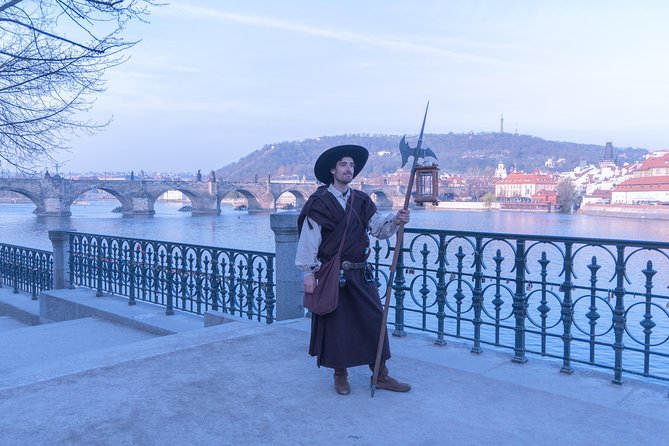
What I love most is the small-group feel and how seriously the guides commit to the role. Guides like Thomas, Oscar, and David show up with proper character energy, staff or lantern props, and a steady stream of street-level details and humor that keep it from turning into a lecture.
The one drawback to plan for: it runs in all weather and the route is mostly on foot, so if you get cold or tired easily, bring layers and good shoes.
In This Review
- Key Things I’d Flag Before You Go
- Why This Night Watchman Walk Feels Different From Usual Prague Tours
- Price and Timing: Does $26.62 Buy Real Value?
- Meeting Point Reality: Powder Tower to Charles Bridge
- Stop 1: Prasna brána and the 13 Gates Story
- Stop 2: Ovocný trh and the Food of Common People
- Stop 3: Theatre Des États, Mozart, and Il Commendatore
- A Key Passing Moment: The First Middle European University
- Stop 4: Old Town Hall and the Astronomical Clock Square
- Stop 5: Jan Hus Monument and the Hussite Threads
- Stop 6: Church of Our Lady before Týn (From 1368)
- Stop 7: Rudolfinum Pass-By and a Riverside Pause
- Stop 8: Charles Bridge at the Start and Charles IV
- The Nightwatchman Experience: What to Expect From the Guide
- Weather, Walking, and Practical Tips That Actually Help
- Who Should Book This Tour (and Who Might Skip)
- Should You Book This Medieval Prague Through a Nightwatchman’s Eyes Tour?
- FAQ
- How long is the night watchman walking tour?
- Where does the tour start and end?
- What language is the tour offered in?
- Is the tour good for families?
- Is the tour in bad weather?
- How active is it?
- What’s included in the price?
- Are there tickets to pay at the stops?
- How many people are in the group?
- What is the cancellation policy?
Key Things I’d Flag Before You Go
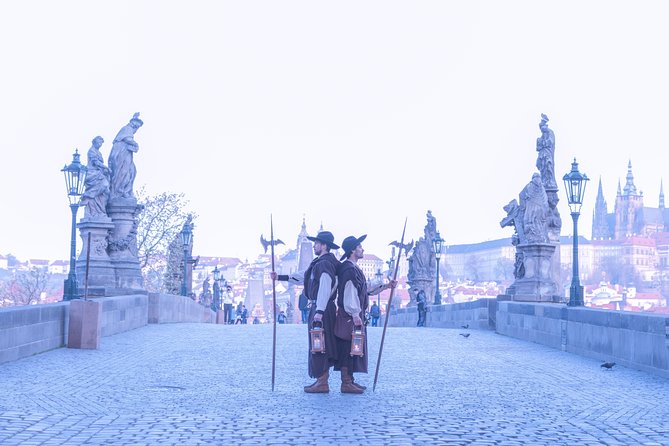
- Costumed storytelling that stays in character for the whole walk, not just at the start
- Small group size (max 15), which makes it easier to ask questions and stay connected to the guide
- An efficient 90 minutes with stops spaced through Old Town highlights plus side-street moments
- A night setting that helps the grim topics feel real instead of abstract
- Practical route flow, starting at Nám. Republiky near Powder Tower and ending at Charles Bridge
Still weighing up how to spend your days in Prague? These are the tours travellers book most.
- Prague: 50-Minute Sightseeing Evening Cruise★ 4.2 · 33,780 reviews
- Prague: Medieval Dinner with Unlimited Drinks★ 4.4 · 19,847 reviews
- Prague: Castle Tour with Local Guide and Entry Ticket★ 4.6 · 10,422 reviews
- Prague: Oldtown, Medieval Underground & Dungeon History Tour★ 4.3 · 10,277 reviews
Why This Night Watchman Walk Feels Different From Usual Prague Tours
Prague has plenty of tours that say the same nameplates and move on fast. This one changes the pace by giving you a job to think about, not just a list of places to photograph. You walk as the city would have looked to someone trying to keep order and notice trouble at night.
The biggest difference is the guide’s approach: you’re guided through medieval and early-modern Prague using the night watchman lens, with stories about executions, mysteries, and everyday street life. The tone can be dark, but it’s also playful. Several guides have been praised for being funny and engaging while still delivering real context, and that balance matters. It keeps the topic heavy without making it gloomy.
And because the group stays small, the character work lands better. You’re not one face in a crowd. You can hear the details, ask something when you’re curious, and follow the turns without feeling rushed.
Price and Timing: Does $26.62 Buy Real Value?
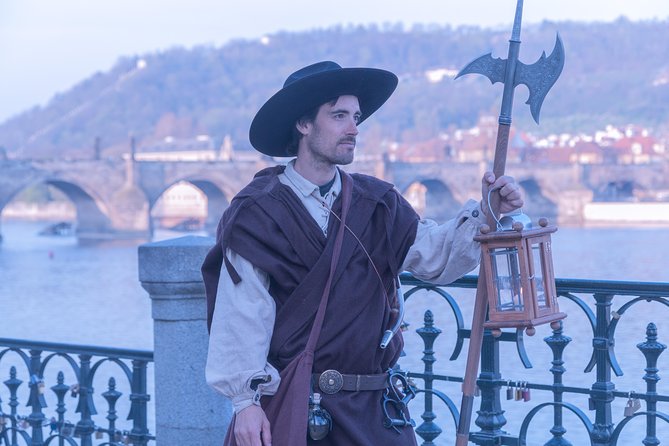
At $26.62 per person for about 1 hour 30 minutes, you’re paying for a guided experience that bundles the guide, the storytelling, and the fact that multiple key sites are part of the walking route. The tour includes taxes and has a local tax component, plus the guide works in historical dress.
Also worth noting: it’s capped at 15 travelers, and that usually means better interaction and a smoother pace than big-bus sightseeing. On a short evening window, that’s a big deal.
The tour is offered in English, and you receive a mobile ticket. You’ll want to plan to meet at the start point yourself, since hotel pickup and drop-off aren’t included and there’s no transportation to/from stops. Still, most people can reach the central start area by foot or tram without much trouble.
Meeting Point Reality: Powder Tower to Charles Bridge
The tour starts at Powder Tower (Prasna brána), address Nám. Republiky 5, Staré Město, 110 00 Praha 1. It ends near Charles Bridge, finishing at the Charles IV Statue (Křižovnické nám., Staré Město, 110 00 Praha-Praha 1), at the beginning of the bridge.
This end point is helpful. When the tour finishes, you’re already positioned where most people want to go next: the Charles Bridge approach, with the option to keep walking into the evening atmosphere on your own.
The guide’s route is designed to keep you moving through Old Town without backtracking. You’ll cover a mix of squares, churches, and viewpoints, with frequent short stops that keep the walking from feeling like one long slog.
Stop 1: Prasna brána and the 13 Gates Story
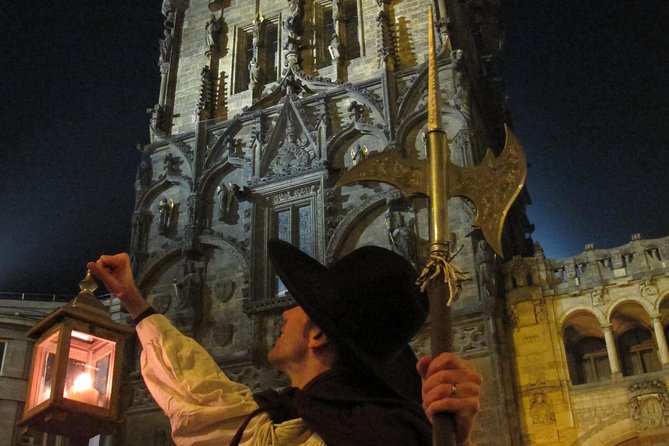
You begin at Prasna brána, the Powder Tower. It’s tied to Prague’s defensive past as one of the 13 gates that once protected the city.
This stop isn’t just about a photo moment. The tour explains how the gate connected to city security and storage, including the role of gunpowder that gave the gate its name. That detail helps you understand why medieval Prague had gates that mattered. They weren’t decorative. They were part of how daily life worked.
Why it’s a smart start: this is a natural way to “turn on” your night-watch perspective right away. If you start at the right threshold, the rest of the walk makes more sense.

Stop 2: Ovocný trh and the Food of Common People
Next comes Ovocný trh, the fruit market area. The key theme here is everyday life: you hear how markets functioned and what food looked like for common people.
Even if you know Prague mostly through architecture, this is where the tour shifts the focus toward how people actually lived. And it even includes a hands-on touch—your guide offers bread of the common people to guests. It’s a small thing, but it changes how you remember the stop. Food-based context tends to stick.
Practical note: this is a stop where you’ll want to stand where your guide can explain clearly, since the area can be busy depending on the evening.
Stop 3: Theatre Des États, Mozart, and Il Commendatore
From the market you move into the world of culture and performance. The tour points you toward Theatre Des États, with a connection to Mozart and the premiere of Don Giovanni.
This part works well because Prague isn’t only a medieval story. Early-modern Prague had courtly life and theater culture. Linking music history to street history helps you avoid the common Prague trap of treating everything as one uniform medieval postcard.
You’ll also pass by the statue of Il Commendatore, which the tour connects back to the first performance of Don Giovanni in 1787. It’s a reminder that stories travel through places in physical form. A statue isn’t just a landmark; it’s a prompt to ask what the city chose to remember.
One more thing you’ll notice: you’re walking while your guide keeps tying the city together through themes. That’s what makes the path feel like a story instead of a route.
A Key Passing Moment: The First Middle European University
Along the way, the tour passes by the first middle European university. The stop isn’t long, but it adds an important layer: this city wasn’t only about trade and defense. It was also about learning.
Even a quick mention helps. It gives you a more complete idea of Prague’s status in the broader region. If you’re the type who likes context, this kind of “drive-by” detail often becomes one of the things you remember later.
Stop 4: Old Town Hall and the Astronomical Clock Square
Now you reach the heart of the Old Town atmosphere at Old Town Hall with the Astronomical Clock.
This is where the tour turns to civic power and public spectacle. You’ll hear about the town hall and the market place, with a focus that includes the defenestration and executions that took place in this kind of public space.
If you’ve ever looked at Prague squares and wondered why they feel tense or theatrical, this is the answer. Those spaces were where authorities demonstrated control. They were also where crowds gathered and rumors spread.
The 20-minute time here is built for more than quick sightseeing. It gives your guide room to connect the clock-and-square visuals to what those streets meant to people living through conflict and punishment.
Stop 5: Jan Hus Monument and the Hussite Threads
Then you stop at the Jan Hus Monument, with attention to the Hussites of Prague in the 14th and 15th century context.
This moment matters because it widens the story from individual events to the broader ideological currents shaping Prague. It’s one of those stops where the tour makes you think beyond the stonework: who influenced the city, who resisted, and why beliefs became public matters.
If you like history explained through cause and effect, this stop will feel like a hinge point. You move from civic events into the religious and political pressures that fed them.
Stop 6: Church of Our Lady before Týn (From 1368)
Next up is the Church of Our Lady before Týn, tied here to the 1368 date.
The tour keeps this portion brief, about 5 minutes, but it’s still useful. You get a sense for Prague’s medieval religious landscape and why churches dominated skylines and city identity.
Even if you’ve seen similar Gothic silhouettes elsewhere, Prague’s churches often carry a feeling of continuity. The tour uses that visual presence to keep the medieval timeline alive as you move onward.
Stop 7: Rudolfinum Pass-By and a Riverside Pause
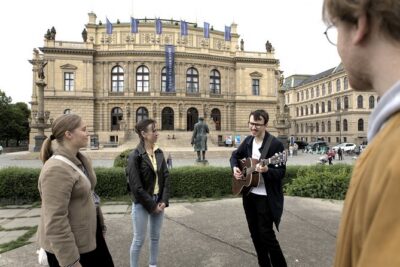
You pass by Rudolfinum and then take a 15-minute break at a quiet spot along the riverside.
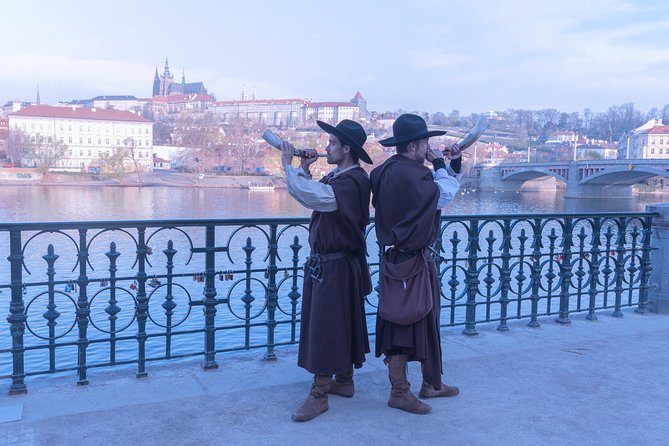
This is one of the smartest parts of the tour. You get a pause after walking and story-heavy stops, plus you’re placed where you can actually look out at the city instead of just moving through it. The guide also sets you up for photos and calm time with a view toward Prague Castle.
This break is also practical. On a cold or rainy night, a built-in stop reduces the urge to rush the entire walk just to get it over with.
If the weather is rough, take advantage of the pause. Warm up your hands, re-check your layers, then settle back into the final push toward Charles Bridge.
Stop 8: Charles Bridge at the Start and Charles IV
The tour ends at the beginning of Charles Bridge. You get about 15 minutes here, and the guide talks about nobles from the other side and connects the bridge story to Charles IV.
Charles Bridge is one of Prague’s most famous images, so the value of this stop is not in telling you where the bridge is. It’s in adding meaning. When you understand who had influence across the river and why the bridge mattered, the scene shifts from tourist crowd to historical crossing.
Also, ending at the bridge approach gives you freedom. After the tour, you can keep strolling without worrying about transit back to a separate meeting location. You’re already in a scenic zone where it makes sense to linger.
The Nightwatchman Experience: What to Expect From the Guide
This tour isn’t just about buildings. It’s about performance style.
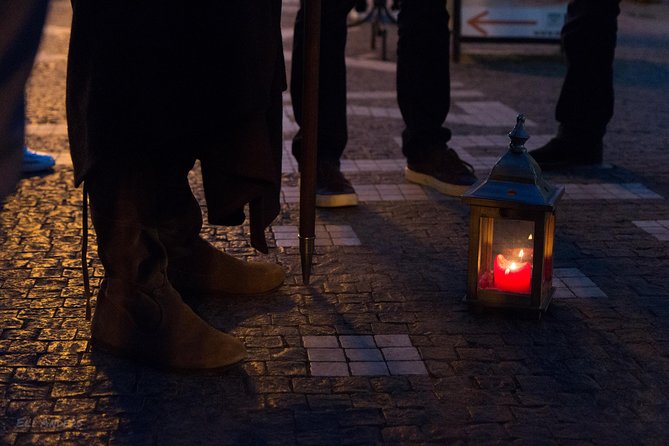
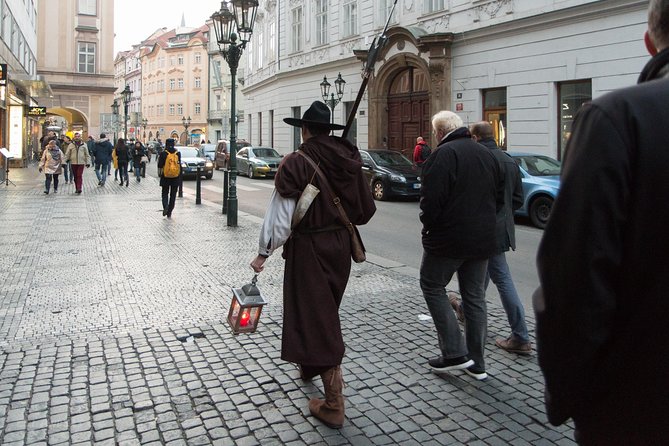
Guides in this series have been praised for staying in character for the entire walk and using props such as a lantern and staff/halberd for photos. There are mentions of humor and engaging delivery that kept everyone moving and listening, including kids in at least one group.
A detail I’d treat as a plus: your guide’s commitment shows in how they handle obstacles. There’s feedback about the guide working around unexpected issues without breaking the flow of the story.
So if you’re choosing between multiple Old Town walking tours, this is the one that feels most like a street play tied to real places.
Weather, Walking, and Practical Tips That Actually Help
The tour operates in all weather conditions, so plan clothing like you’ll be outside for the full 90 minutes. If it’s cold, bring layers you can add or remove quickly. Good shoes matter because Prague streets are uneven in places.
The route calls for moderate physical fitness. That usually means you’re walking continuously but with short stops. If you’re comfortable with typical city walking, you’ll be fine.
Also, keep an eye on the time of night. You’ll be in darker areas, so it helps to have a phone flashlight ready (brightness low, so you don’t blind anyone nearby).
If you’re traveling with kids, they must be accompanied by an adult. The storytelling style has worked for families before, but it’s still an evening walking tour, not a sit-down show.
Who Should Book This Tour (and Who Might Skip)
This tour is best for you if:
- You want a way to learn Old Town without feeling like you’re stuck in a classroom.
- You like your history with a human voice, humor, and character.
- You enjoy short stops that connect one square, church, or bridge to a larger story.
You might skip it if:
- You dislike darker themes like executions in general.
- You get uncomfortable in cold, rainy evenings and hate flexible outdoor plans.
- You only want top-tier photo stops and prefer not to walk between explanations.
Should You Book This Medieval Prague Through a Nightwatchman’s Eyes Tour?
If you’re spending a limited time in Prague and want one evening that feels different, I’d book it. For $26.62 you get a committed costumed guide, a focused Old Town route, and a storyline built around daily life after dark. The “small group, character all the way through” style is the real value, not just the landmark list.
One more reason to lean yes: the route ends where you want to be next. Ending at the start of Charles Bridge gives you a natural flow into your own exploring afterward, rather than sending you back to the starting area.
If you want Prague history served with atmosphere, this is one of the best ways to do it.
FAQ
How long is the night watchman walking tour?
It lasts about 1 hour 30 minutes.
Where does the tour start and end?
It starts at Prasna brána (Powder Tower) at Nám. Republiky 5, Staré Město and ends at the Charles IV Statue near Charles Bridge at Křižovnické nám., Staré Město.
What language is the tour offered in?
The tour is offered in English.
Is the tour good for families?
Children must be accompanied by an adult, and the tour’s storytelling style has worked well for kids in at least one family group setting.
Is the tour in bad weather?
Yes. It operates in all weather conditions, so dress appropriately for rain and cold.
How active is it?
You should have moderate physical fitness, since it’s a walking tour with multiple stops.
What’s included in the price?
The price includes all taxes and fees, plus a guide in historical dress.
Are there tickets to pay at the stops?
The listed stops are shown as admission ticket free in the tour details you’ll follow during the walk.
How many people are in the group?
There’s a maximum of 15 travelers.
What is the cancellation policy?
You can cancel for a full refund if you cancel up to 24 hours in advance. If you cancel less than 24 hours before the start time, the amount paid is not refunded.