
REVIEW · TOURS
Kafka’s Prague Small Group Tour
Kafka’s Prague isn’t about plaques. It’s about addresses that shaped his writing.
This small-group walk threads Franz Kafka’s life through real locations in Old Town and the New Town, with stop-by-stop context you can actually use while you’re sightseeing. Two things I really like: the way Radek’s stories connect the buildings to Kafka’s works, and the route ends with a well-timed pause at Café Louvre.
You should know one possible drawback: it’s mostly outside and on uneven city streets. If the weather is bad or you’re sensitive to lots of walking, plan accordingly.
In This Review
- Key things that make this tour worth your time
- Kafka’s Prague feels different when you walk it by address
- Meeting at Nám. Franze Kafky 24/3: start where the story begins
- From Kafka’s birth relief to the House at the Minute
- The House of the Three Kings and the rooms that sparked writing
- Kinský Palace: school-leaving certificate and family ties
- Art Nouveau apartments: the Golden Pike years
- Two monuments and two story connections: struggle, Metamorphosis, and a desk
- The Old-New Synagogue: Prague’s ghetto changing around him
- Oppelt House on Old Town Square: a last Prague address
- Karl-Ferdinand University and the courtroom corridors that shaped The Trial
- From workers’ insurance to cafés: Kafka worked, then he watched
- David Černý’s rotating Kafka head and the included drink at Café Louvre
- Price and logistics: $34.30 for a focused, small-group route
- Who this tour suits best (and who might want to adjust expectations)
- Should you book Kafka’s Prague Small Group Tour?
- FAQ
- How long is the Kafka’s Prague Small Group Tour?
- What’s the price per person?
- Is the tour offered in English?
- Where do I meet and where does the tour end?
- Does the tour include a drink?
- What is the cancellation policy?
Key things that make this tour worth your time
- Small group (max 6) means you get real conversation, not just headsets and silence.
- Guide Radek brings a personal, friendly tone and explains how Kafka thought and wrote.
- Hand-picked Kafka quotes tie specific passages to the exact places you’re standing.
- Pictures of buildings then vs. now help you picture Prague in Kafka’s day.
- All listed stops are admission-free, so you’re not paying repeatedly to see outdoor-facing sites.
- A drink at Café Louvre is included, which makes the last stretch feel like a proper finale.
Still weighing up how to spend your days in Prague? These are the tours travellers book most.
- Prague: 50-Minute Sightseeing Evening Cruise★ 4.2 · 33,780 reviews
- Prague: Medieval Dinner with Unlimited Drinks★ 4.4 · 19,847 reviews
- Prague: Castle Tour with Local Guide and Entry Ticket★ 4.6 · 10,422 reviews
- Prague: Oldtown, Medieval Underground & Dungeon History Tour★ 4.3 · 10,277 reviews
Kafka’s Prague feels different when you walk it by address
Prague can be a little too easy to skim. You look, you snap photos, you move on. This tour slows that down in a smart way: you don’t just see famous spots, you learn why Kafka cared about them and what they may have triggered in his work.
What I like most is the cause-and-effect feel. The tour doesn’t treat Kafka like a distant statue. It treats him like a person walking through a city—schooling, studying, working, waiting, worrying, and then writing.
It also works whether you’re a deep Kafka reader or a “first-time visitor” type. If you know Metamorphosis already, you’ll recognize how the stops point to ideas behind it. If you don’t, you still get enough context to follow along without feeling left behind.
Meeting at Nám. Franze Kafky 24/3: start where the story begins
You begin at Nám. Franze Kafky 24/3, in Staré Město (Old Town). It’s a fitting start: Kafka’s name is built into the place from the first minute, so the whole route feels grounded instead of random.
This is an English-language tour with a mobile ticket. It’s also designed to be doable during a normal sightseeing day because it runs about 3 hours. And since the max group size is 6, you’ll usually hear the guide clearly without needing to fight the crowd.
Practical tip: wear comfortable shoes. This is a city-center walking tour, and Prague’s sidewalks can be uneven. Even with short stops, you’ll still cover a meaningful distance.
From Kafka’s birth relief to the House at the Minute
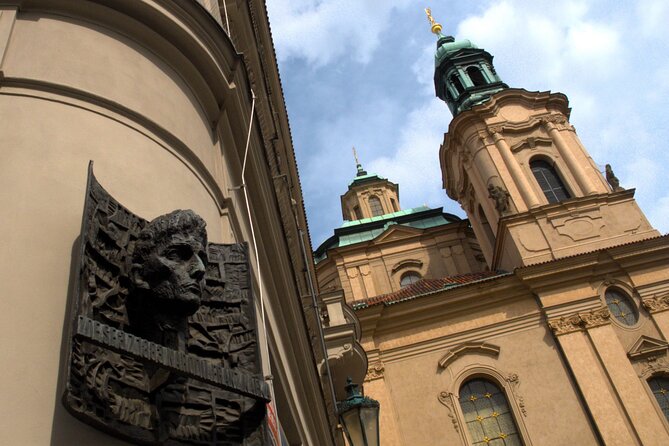
Your first stop is at Nám. Franze Kafky 24/3, where you’ll meet the Kafka birth commemoration. The original house connected to Kafka’s birth is gone, but the area remembers him with a relief by Karel Hladík on the façade at No. 3.
This is a good opening because it sets expectations. You’ll learn how Prague preserves Kafka through small details—not only with grand monuments, but also with careful reminders.
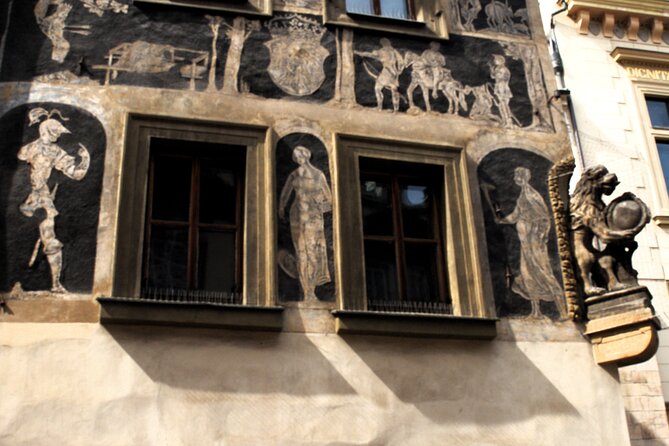
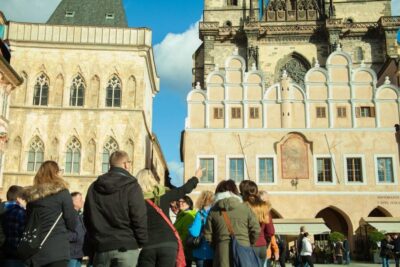
Then you move to Staroměstské nám. 3/2 and the House at the Minute. Here, the tour focuses on childhood and early schooling. You’ll hear about how formative events and family life fed Kafka’s inner world, and you’ll also spot the building’s Renaissance sgraffito and the stone lion symbol—details you’d probably miss if you were walking past without guidance.
Why this stop matters: Kafka’s stories often feel precise and structured. Starting with these early, everyday surroundings helps explain that tone.
The House of the Three Kings and the rooms that sparked writing
Next comes Celetná 602/3, linked to the House of the Three Kings. This is one of the more emotionally charged stops because it’s about Kafka getting a more personal space—his own room with a desk—where he made early literary attempts.
The tour also brings in a reminder that Kafka’s Prague wasn’t calm and tidy. You’ll connect this address to national riots between Czechs and Germans, a tense backdrop that shaped the atmosphere of the time.
From a visitor’s perspective, this stop is a masterclass in how to read a city. You’re not just looking at a façade. You’re learning to ask: what kind of life happened in these walls?
Kinský Palace: school-leaving certificate and family ties
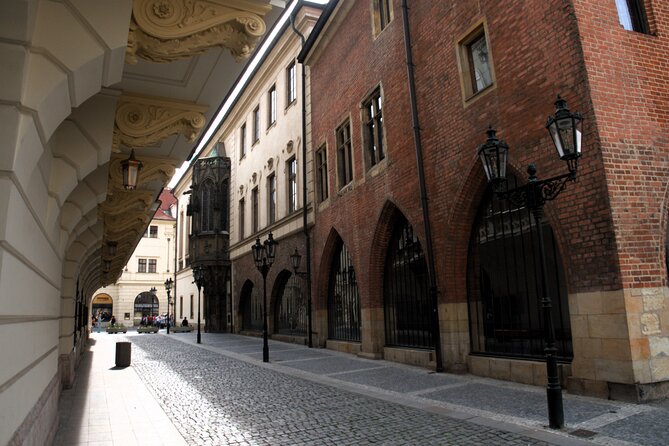
At Kinský Palace, you’ll learn how the K. K. State German Language Secondary School in Prague relates to Kafka’s student years. It’s the sort of detail that makes the biography feel real: Kafka’s education isn’t abstract. It’s tied to an actual building and the moment he received his school-leaving certificate.
This stop gets extra interesting because it also connects to Kafka’s family. The palace was, for a time, tied to a shop run by his father, Hermann Kafka.
If you like tours that show the overlap between family, work, and education, you’ll appreciate this one.
Art Nouveau apartments: the Golden Pike years
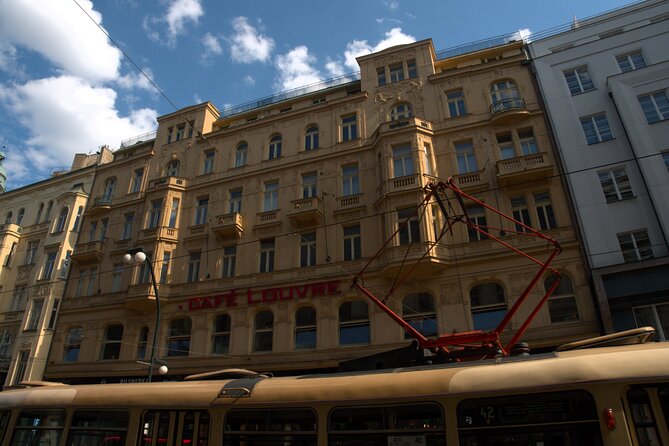
Then you head to Dlouhá 705/16, the At the Golden Pike apartment house built in 1914. Kafka moved there about a year later and stayed for nearly two years.
This matters because it frames one of the quiet realities of writing: it doesn’t happen in a museum. It happens in rooms where you live day after day—arranging schedules, managing health, and thinking while Prague goes on around you.
You’re also given time to look closely. Even though the building isn’t a museum stop, it’s still useful to see how Kafka’s life sits inside Prague’s layered architecture.
Two monuments and two story connections: struggle, Metamorphosis, and a desk
The tour then shifts from addresses to symbolism with two key “read the art” moments.
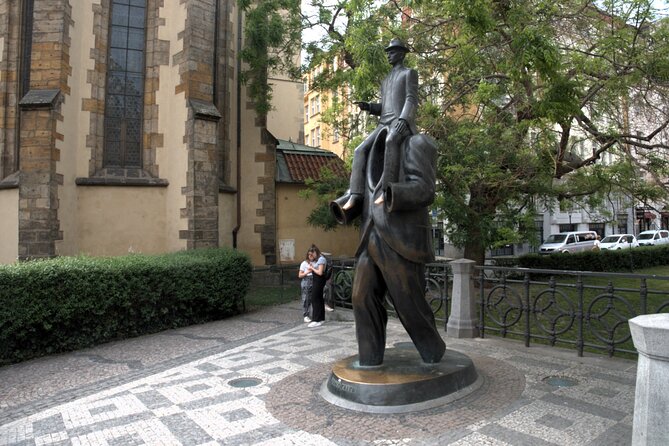
At the Statue of Franz Kafka by Jaroslav Rona, you’ll see a monument inspired by Kafka’s short story A Description of a Struggle. The statue is also tied to Metamorphosis, so you get a double line of meaning even if you’re not a scholar of Kafka.
Then there’s Pařížská 36, linked to the House of the Ship, where Kafka wrote his famous short story Metamorphosis.
These stops are quick, but they’re useful. Monuments can feel like they’re just for photos. This one helps you treat them like shorthand for themes—effort, transformation, and tension.
The Old-New Synagogue: Prague’s ghetto changing around him
Next comes the Old-New Synagogue. The tour places this within Kafka’s childhood and youth, when the former Jewish quarter—often described as a ghetto area—was being transformed.
You’ll learn that older, poorer houses were being replaced by newer luxury apartment blocks. And you’ll understand why only a few structures remain from the original area, including the Gothic Old-New Synagogue.
The guide also discusses Kafka’s relationship with Judaism. This is the kind of part that can move quickly if the tour doesn’t slow down. Here, it’s treated as something worth pausing for, not just checking off.
If you care about how identity and family background show up in literature, don’t skim past this stop.
Oppelt House on Old Town Square: a last Prague address
At Staroměstské nám. 934/5, the tour points to Kafka’s last address in Prague, the Oppelt House, on Old Town Square.
This part turns more personal and more human. Kafka lived there in the care of his parents as he dealt with advanced lung disease shortly before his death.
What you’ll likely notice is the tone shift. The walk doesn’t suddenly become depressing. It becomes focused—on how time and health pressure a life, and how writing can become even more urgent.
Karl-Ferdinand University and the courtroom corridors that shaped The Trial
Then you move to Karolinum, connected to Kafka’s law studies at Karl-Ferdinand University. Here, he received his doctorate in law. The timing is mid-14th century for the building, so you’re seeing a place that has outlasted many generations of students.
After that, the tour stops at Ovocný trh 14, the State Civil Court building, where Kafka did part of his compulsory legal clerkship. The guide connects the building’s endless corridors, waiting rooms, and courtrooms to the mood behind The Trial.
This is a big “aha” moment for many visitors. If you’ve read The Trial, you probably remember the feeling: trapped, delayed, judged without clarity. Seeing the setting that likely sparked those impressions is powerful.
If you’re the type who enjoys “how an idea gets born,” you’ll love this section.
From workers’ insurance to cafés: Kafka worked, then he watched
Next comes Na Poříčí 17, tied to the former Workers’ Insurance Company for the Kingdom of Bohemia, where Kafka worked until health forced him to retire.
This is one of those stops where the guide makes biography feel practical. Kafka’s life wasn’t only writing-time. There was a work world around him, full of rules and institutions—the sort of setting that shows up in the way his stories operate.
Then the tour heads to Hybernská 1004/16 for Café Arco, described as one of Kafka’s favourite places and tied to cultural life at the time.
If you’re wondering why a writing tour ends up in cafés, here’s the honest answer: Prague writers and thinkers gathered in social spaces. A café stop gives you a real sense of rhythm—how talk, ideas, and observation blended.
David Černý’s rotating Kafka head and the included drink at Café Louvre
The tour’s final stretch becomes even more modern.
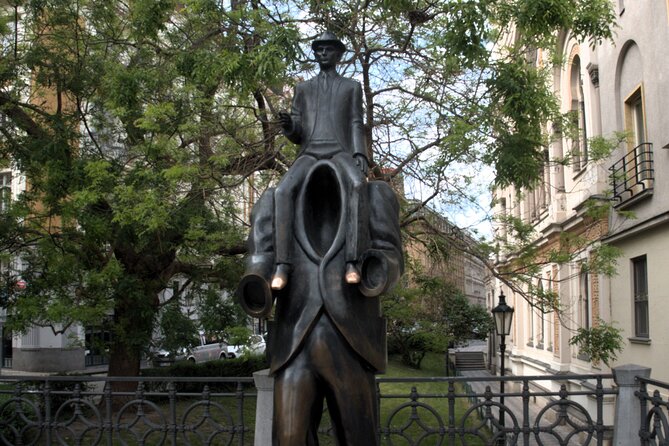
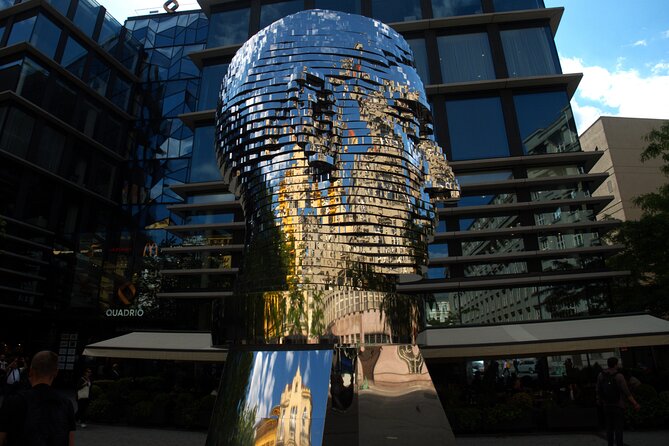
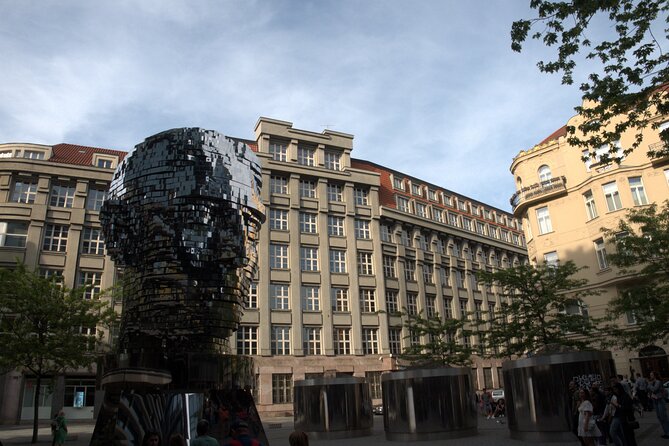
At Franz Kafka – Rotating Head by David Černy, you’ll see one of the most famous Kafka memorials: a mechanical rotating statue depicting his head. It’s a striking visual metaphor for how Kafka’s work keeps turning in people’s minds.
After that, you finish at Národní 1987/22, at Café Louvre. The guide explains that it was another important cultural hangout and notes that it has retained much of its original atmosphere.
You’ll also get a real bonus: the price of your drink is included in the tour price. Take advantage of this. It’s not just a payment perk. It’s where the tour stops being “walking facts” and becomes a break in the middle of a real city day.
It also helps you extend the experience after the tour. You’re right on the edge of Old Town and New Town, close to tram and metro, so it’s easy to keep going.
Price and logistics: $34.30 for a focused, small-group route
At $34.30 per person for about 3 hours, this tour sits in a sweet spot. You’re not paying for expensive museum entries. Most stops are admission-free, and you’re buying context, timing, and good storytelling from a local guide.
The small group size (max 6) is part of the value. You’re not just buying “Kafka locations.” You’re buying the ability to ask questions and hear your guide clearly when the tour turns more interpretive—like the symbolism of the monuments or the link between legal corridors and The Trial.
Language is English, so you’ll get all the narrative thread. And the mobile ticket keeps things simple.
One practical thought: since you’re outdoors for the bulk of the route, plan for weather. If it’s rainy, bring a jacket you can move in. If it’s hot, treat the café segment as part of your pacing strategy.
Who this tour suits best (and who might want to adjust expectations)
I think this tour works best if you want more than a checklist of buildings. If you like literature tours that explain why a location matters, you’ll feel the payoff.
It’s also great if you enjoy seeing “then vs. now” through guide-provided pictures and if you like connecting lines from Kafka’s writing to the places those ideas might have come from.
If you’re traveling with limited time and want a quick, scenic hit of Prague, you might feel this is more “story walk” than “architecture grand tour.” It’s still Prague. You’ll see plenty. Just don’t expect long interior museum time.
Should you book Kafka’s Prague Small Group Tour?
Yes—if you’re willing to slow down and let the city explain Kafka. This is the kind of tour where you walk away with a stronger sense of Prague as a lived-in set of circumstances, not a postcard set.
Book it if you want:
- a small-group experience with guide Radek at the center
- location-by-location storytelling tied to Kafka’s works
- an end stop at Café Louvre where you can sit, drink, and let the route land
Skip it only if you strongly prefer fully indoor attractions or you can’t manage a few hours of walking in central Prague.
If you’re even mildly curious about Metamorphosis, The Trial, or The Castle, this tour gives you a way to place those stories inside real addresses. That’s the real value here.
FAQ
How long is the Kafka’s Prague Small Group Tour?
The tour lasts about 3 hours.
What’s the price per person?
The price is $34.30 per person.
Is the tour offered in English?
Yes, the tour is offered in English.
Where do I meet and where does the tour end?
You start at Nám. Franze Kafky 24/3, Staré Město and the tour ends at Café Louvre, Národní 1987/22, Nové Město.
Does the tour include a drink?
Yes. At Café Louvre, the price of your drink is included.
What is the cancellation policy?
You can cancel for free up to 24 hours in advance for a full refund. If you cancel less than 24 hours before the start time, the amount paid is not refunded.
More Tours in Prague
More Tour Reviews in Prague
More Prague tours we have written up lately


Tours, compared.
 ★ 4.6Castle Tour with Local Guide and Entry TicketFrom $6110,422 reviews
 ★ 4.3Oldtown, Medieval Underground & Dungeon History TourFrom $3110,277 reviews
 ★ 4.7Prague Castle 2.5-Hour Tour Including Admission TicketFrom $578,927 reviews
 ★ 4.73-Hour Walking Tour of Old Town & Prague CastleFrom $305,696 reviews
 ★ 4.83-Hour Old Town and Prague Castle Tour in GermanFrom $365,671 reviews
 ★ 4.4Ghost Walking Tour Where Legends Come To LifeFrom $275,253 reviews
 ★ 4.3Ghosts, Legends, Medieval Underground & Dungeon TourFrom $315,104 reviews
 ★ 4.5Klementinum Library & Astronomical Tower Guided TourFrom $185,050 reviews